A framework for turning one-time incentives into lasting loyalty, first presented at App Growth Summit México City.
At App Growth Summit México City, we opened our workshop by inviting the audience to take part. Attendees who engaged earned gift cards and rewards on the spot.
The audience gave their attention, time and participation. We gave something of value back. That is a value exchange, and it is the same principle every loyalty program runs on.
The harder question is what happens after the reward. A gift card gets someone to participate once. It does not make them come back. The gap between a single action and lasting loyalty is what this framework is about.
Here is the model we shared, and three questions any loyalty team can use to put it to work.
What is a value exchange in loyalty?
Every loyalty program runs on an exchange, whether the brand designs it on purpose or not. The consumer gives attention, time, engagement and action. The brand gives rewards, benefits, experiences and utility.
When value only flows one way, the program becomes a discount the brand pays for and the member forgets. When value moves both ways, the program becomes a reason to come back. Value has to move in both directions.
Why an incentive is not loyalty
Most programs are built to trigger a transaction: points for a purchase, a coupon for a visit, a bonus for signing up. Those incentives work. They drive an action.
But an action is not loyalty. A member who buys once because of a discount has not built a relationship with the brand. They responded to an offer, and the next offer from a competitor can pull them away just as easily.
What happens between one purchase and the next?
This is the question we believe most loyalty strategies skip.
In a traditional program, a member makes a purchase on Monday. Then nothing happens. We call it dead time: the days or weeks when the app sits unopened and the brand is out of mind. The next purchase is a question mark.
In an engagement-driven program, the same member buys on Monday, then opens the app on Tuesday for a mission, on Wednesday to keep a streak, on Thursday for a bonus and on Friday to claim a reward. By Saturday, the next purchase feels natural.
What happens in the space between purchases is what becomes habit.

How an incentive becomes a habit
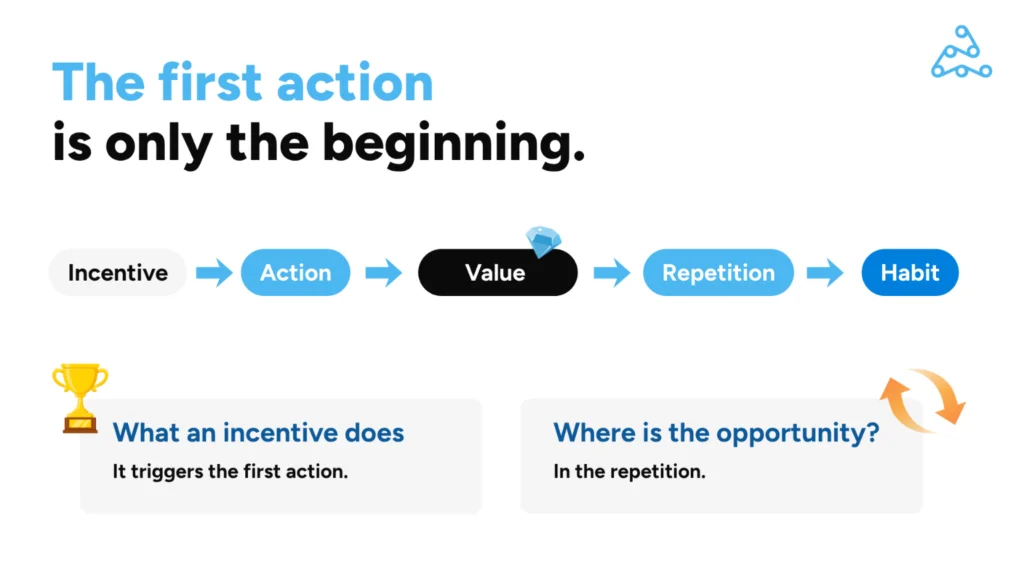
The first action is only the beginning. Habit is built through a sequence:
- Incentive. A reason to try something once.
- Action. The member engages.
- Value. The experience delivers something worth having.
- Repetition. The member comes back because the value was real.
- Habit. Returning becomes part of their routine.
An incentive triggers the first action. The opportunity is in the repetition. And repetition only happens when the value is real.

What this looks like in practice
Consider one of our loyalty partners: a leading U.S. convenience store chain with an established rewards app. The program already worked. The challenge was the time between visits, and the large group of customers who only stop for fuel and never walk into the store. They needed more reasons for members to open the app without asking for an extra purchase.
The solution was an advertiser-funded mobile gaming experience inside the rewards program. Members play games, complete challenges and earn rewards in the brand’s own currency. Game advertisers fund the rewards, so there is no cost to the brand and no pressure on margin.
Everyone in the exchange wins. The member earns real rewards from a program they already use. The game advertiser reaches engaged players. The brand earns loyalty through member habit.
Repetition showed up fast:
- 37% of members who played once came back to play again.
- 12 app sessions per player per month, on average.
- $27+ in monthly rewards earned per user.
Three questions to turn an incentive into a habit
Any loyalty team can apply this model. It comes down to three questions:
- What result do you want? More app opens, more store visits, higher frequency, a new revenue stream. Start with the behavior you need to change.
- What does your user value? Not what the brand wants to give, but what the member actually finds worth their time.
- How do you deliver that value? The format, the frequency and who funds it. This is where advertiser-funded models open options that discounts cannot.
The incentive creates the first action. Repetition creates the habit. Value keeps the exchange going.
Frequently asked questions
What is the difference between an incentive and a habit in loyalty? An incentive is a one-time reason to act, like a discount or bonus points. A habit is a repeated behavior driven by ongoing value. Incentives drive transactions; habits drive loyalty.
How can a loyalty program increase engagement between purchases? By giving members reasons to open the app that do not require a purchase, such as missions, streaks, games and rewards that build over time.
What is an advertiser-funded rewards model? A model where third-party advertisers fund the rewards members earn inside a brand’s loyalty program. Members get more value, and the brand adds engagement without increasing its own reward costs.
Can this model work for programs in Latin America? Yes. The framework is market-agnostic, and mobile-first audiences across LATAM are a strong fit for engagement-driven loyalty.
Want to turn your loyalty program’s dead time into daily habit? Talk to our partnerships team about bringing advertiser-funded engagement to your members.
The post From Incentive to Habit: How Loyalty Is Built Between Purchases appeared first on AdAction.