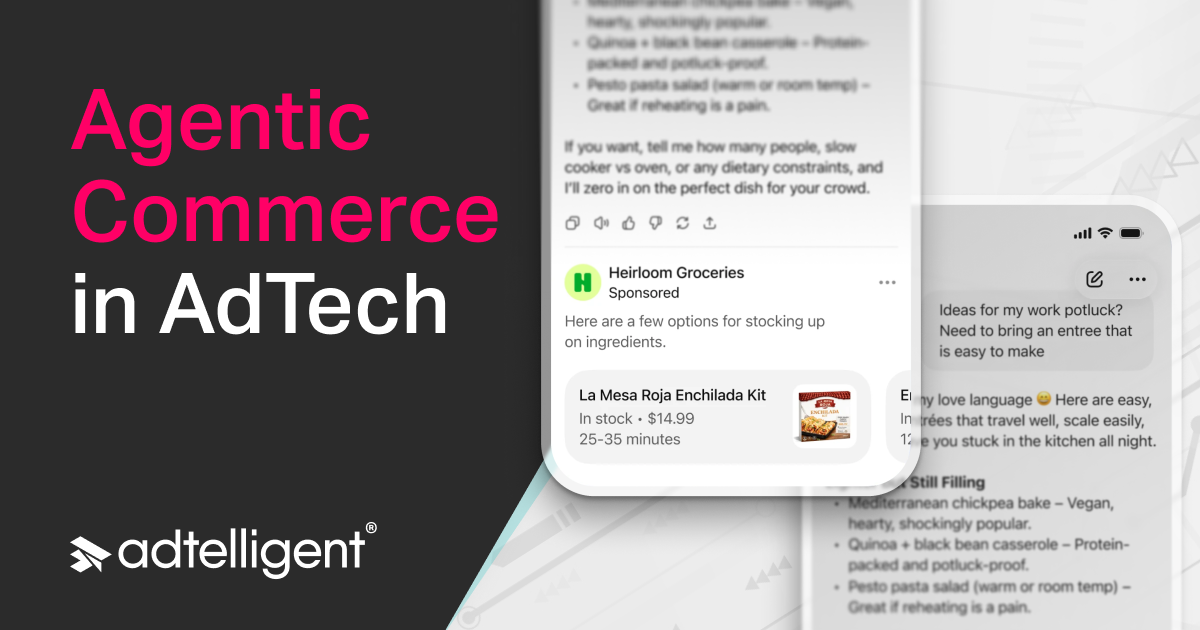
A year ago, most marketers still thought of ChatGPT as a writing assistant. Now retailers are treating it as a storefront, brands are paying to show up inside its answers, and whole ad categories are being redrawn around conversations instead of clicks. Something bigger than “AI hype” is happening here. A new layer of commerce, agentic commerce, is quietly forming on top of the web we already know, and it’s pulling advertising along with it.
What Is Agentic Commerce?
Agentic commerce is the shift where AI assistants help people discover, compare, and shortlist products, usually still handing off the actual purchase to the retailer. It isn’t about bots running off with your credit card. It’s closer to having a very patient shop assistant who has already read every review and can pull up options tailored to what you asked for in plain language.
The historical analogy almost writes itself. Mobile didn’t kill desktop. Social didn’t replace search. E-commerce didn’t end physical retail, even though people panicked about it at the time. Each wave added a new layer, and ad budgets followed the attention. Agentic commerce is doing the same thing, only faster.
Industry tracking this year shows that roughly 60% of online shoppers have already used an AI tool during the research phase of a purchase, and Gartner has projected that traditional search engine traffic will drop by around 25% as people lean on AI assistants instead. Those are big numbers if you make money from search ads, and they’re exactly why LLMs and assistants now matter for adtech. They’re not replacing discovery: they’re adding a whole new layer of it.
A concrete example: in May 2026, OpenAI rolled out an early version of its ChatGPT Ad Manager interface for selected advertisers. The platform allows users to create campaigns, ad groups, set budgets, CPC limits, and track conversions. This marks a shift from basic reporting toward a more полноценный campaign management system.

For the broader backdrop of where programmatic is heading, this overview of programmatic advertising trends is solid material.
The Fragmentation of Product Discovery
For a long time, “where do people find products” had a pretty boring answer: Google, then maybe Amazon. That era is over.
The way people move through the research and consideration stage has fundamentally changed. Users don’t rely on a single channel to evaluate products. Instead, they move across a mix of environments: search engines, social platforms, retail sites, and increasingly, AI assistants. Each of these environments plays a different role: search helps validate options, social shapes perception, retail platforms enable comparison and purchase, while AI assistants accelerate research by summarizing and narrowing choices.
Importantly, AI isn’t replacing earlier touchpoints, it’s entering the process at the consideration stage, helping users structure decisions rather than initiating them.
As a result, there is no single “moment of discovery” or dominant channel anymore. A typical journey might start with passive exposure to a product, continue with structured research via an AI assistant, move into deeper validation in search or retail apps, and end with a purchase influenced by multiple interactions.
For advertisers, this means visibility in just one environment is no longer enough. By the time a user reaches that channel, much of the decision-making may have already happened elsewhere.
AI Assistants Create New High-Intent Ad Placements
Conversational interfaces are doing something strange to the funnel: they’re compressing it. When someone types “best quiet vacuum for an apartment with pets, under $400,” that’s not a vague research query. That’s a buying signal wrapped in a sentence.
These are intent-rich moments, and they happen earlier than the usual moment of conversion. Ads placed here behave differently from banner impressions. Sponsored answers, guided product comparisons, and AI-generated shortlists can influence a decision before the user even opens a retailer tab.
For advertisers, that means the top of the funnel and the decision moment are starting to overlap in ways they never did on traditional search. AI assistants shopping alongside the user is the new normal, and it pushes influence earlier in the journey.
Why Retail Media Becomes Even Stronger
A common misconception over the last year has been that AI assistants will hollow out retail media. The reasoning goes: if people buy through chat, why would anyone need Amazon’s ad network? It’s a tidy story, and it’s mostly wrong.
Here’s what’s actually happening. AI expands both the top and the middle of the funnel. Assistants are new entry points for awareness — someone who wasn’t actively shopping for a humidifier hears about one in a chat and suddenly is. They also help in the messy middle, the part that used to live on blogs and YouTube: comparisons, reviews, “how does this work,” “is this worth the extra $50.” That’s a huge amount of decision-shaping activity, and retailers benefit when it ends on their shelf.
Conversion is shifting, not disappearing. Agent-driven checkout, where an AI actually completes the purchase inside the chat, is emerging as a parallel path, but today most transactions still happen in retailer-controlled environments. Retailers that adapt can support both flows at once: the classic click-to-site path and the newer AI-mediated transaction, while keeping control of pricing, first-party data, and the customer relationship. Done right, they end up with more monetizable placements, not fewer, because every touchpoint that shapes a purchase decision becomes potential ad inventory.
For a deeper breakdown of the numbers, this retail media market outlook explains where retail media trends 2026 are actually heading.
Advertising Becomes the Core Monetization Model for AI Platforms
Every major consumer internet wave has eventually landed on the same business model: ads. Search did. Social did. Video did. AI platforms are heading there too, and the reasons are more practical than philosophical.
Subscriptions are great, but they cap out. The TAM for “people willing to pay $20 a month for a chatbot” is a fraction of the TAM for “people who use chatbots.” Transaction fees are another option, but they require the platform to own checkout, handle returns, deal with fraud, and negotiate with every retailer one by one. That’s painful. Ads, by contrast, are scalable, native to conversation, and, crucially, don’t require the AI platform to own the transaction itself. That’s why AI monetization in adtech is settling into the same pattern we’ve seen before.
For example, Perplexity sells sponsored questions and placements alongside its AI answers, and it doesn’t touch the purchase. The user clicks through, the retailer converts, and everyone wins. Expect more of this pattern: sponsored recommendations, native placements inside AI output, intent-driven ads that look like part of the answer because, structurally, they are.
The parallel story played out in streaming, where subscription fatigue pushed video platforms back toward ad-supported tiers. This piece on video ad monetization strategies covers how those pressures are resolved, and most of the same dynamics apply to AI platforms today.
Hidden Problem: Legacy AdTech Is Not Ready for AI
Here’s the uncomfortable truth. Most existing ad infrastructure wasn’t designed for real-time conversations. It was built for ad calls, auctions, and page loads measured in hundreds of milliseconds, with a long tail of vendors in the chain. Conversational flows don’t tolerate that.
When a user asks an AI a question and expects an answer in two seconds, there’s no room for a sluggish bidding chain with six intermediaries in the loop. Latency kills the experience. Plenty of ad stacks also don’t ingest structured product data well; they were built to render creatives, not to reason over SKUs, prices, and availability. That’s a problem when the ad itself has to match a very specific query.
This is going to be the central fight over the next two years: who can actually serve ads inside conversations without breaking them.
Data & Speed: The Backbone of Agentic Advertising
Agentic advertising depends on three things working together. Real-time product data, so the assistant isn’t recommending something out of stock. Live pricing and availability, because nothing destroys trust like a “$199” suggestion that turns out to be $289 at checkout. And clean metadata, like attributes, reviews, shipping windows, compatibility, because that’s what lets the model actually reason about whether a product fits the ask.
Latency matters for all of it. If the system can’t respond in under a second, it’s out. Real-time bidding in an AI world is a harder problem than it was on the open web, because there’s a user literally waiting on a sentence. The key message is boring but true: AI fails without infrastructure.
How Adtelligent Enables AI-Driven Advertising
As advertising expands into new environments, including conversational interfaces and AI-assisted experiences, visibility into performance becomes increasingly important.
When using the Adtelligent Retail Media Platform, retailers can track and analyze how their campaigns perform across different touchpoints, including placements where users encounter retailer ads within chatbot-like environments or AI-driven interfaces.
This allows retailers to understand how these newer formats contribute to engagement, consideration, and conversion, alongside more traditional channels. Having unified reporting across both established and emerging formats helps teams make informed decisions, optimize campaigns, and evaluate the real impact of AI-influenced user journeys without losing control over data and performance metrics.
The Future: AI + Advertising + Infrastructure
The next chapter isn’t really about chatbots. It’s about AI agents: autonomous workers that handle whole workflows, not single prompts. Research, shortlist, negotiate, compare, and sometimes purchase. Some will be consumer-facing, many will sit quietly inside businesses doing procurement, media buying, or pricing research.
Discovery will keep fragmenting. There won’t be a single “AI Google” to optimize for. There will be dozens of placements, each with its own data, context, and rules, and advertisers will need to show up across them without multiplying cost and complexity by ten.
Advertising itself will remain at the core, because the economics keep pointing that way. The winners in this next phase won’t be whoever has the flashiest model. They’ll be whoever controls the infrastructure, the data, and the monetization logic underneath it all.
FAQs
What is agentic commerce?
Agentic commerce is AI-assisted product discovery and decision-making, where assistants help users compare and shortlist products. The actual checkout still usually happens on a retailer’s site, though agent-driven purchasing is slowly emerging as a parallel path.
Will AI replace e-commerce?
No. AI reshapes discovery and decision layer on top of e-commerce. Retailer ecosystems still own most conversions today and will keep a central role in fulfillment, pricing, and customer relationships for the foreseeable future.
How does AI change advertising?
It shifts advertising from interruption to integration. Instead of banners around content, ads appear inside AI-generated answers as sponsored recommendations and native placements that match user intent more closely than traditional formats.
What is conversational advertising?
Conversational advertising is the practice of placing ads inside dialog-based AI interfaces. Ads are triggered by user queries, shown in line with answers, and depend heavily on real-time product data and contextual signals.
Why is data quality important?
Because AI systems reason over product attributes before recommending anything. Wrong prices, stale stock, or missing specs lead to bad recommendations, and users lose trust in the channel quickly. Clean, structured, up-to-date data is what separates an AI that helps from one that misleads.
How can adtech platforms adapt?
By investing in real-time decisioning, structured product data ingestion, privacy-first targeting, and multi-placement delivery across CTV, web, in-app, and AI. The stack has to be fast, flexible, built for first-party data, and ready for a world where advertising and conversation happen in the same breath.