This is a peek into the research behind our “AI Norms and Values” docs, which we developed over the summer and recently shared on our site. If you’re looking for those, go here:
Back to our story.
Earlier this year, I was spending a lot of time stewing over why everyone around me seemed so frazzled and on edge.
Half the company was spitting mad about all the slop they were getting. Instead of receiving five crisp bullet points, they were getting twenty-page docs full of padding and slop. They would ask a colleague a question, and the reply would begin with “Claude says…” These folks felt like their time and attention were being not just taken for granted, but actively abused.
The other half of the company felt equally injured. They were working faster and delivering better outcomes than ever, and wasn’t this exactly what we had asked of them? They were more upset about the fact that some people hadn’t updated their workflows in years. Of course you can’t keep up if you aren’t willing to adapt, they protested.
Everyone was mad. One side wanted to place limits on AI (“I am so sick of reviewing docs the sender didn’t even read!”). The other side wanted us to force people to use AI (“I am so sick of reviewing docs riddled with basic errors that a single pass would have caught!”)
I was, at different times, in both camps.
But the thing that bothered me most was how often I kept hearing the word “dehumanizing”. People said they no longer felt like they had a human connection with their coworkers anymore. This was new.
My first instinct was to say that tools are tools. The quality of the work is all that matters — outcomes are all that matter — not how the work was made. Do our customers care if we use AI or not? Probably not. They care a lot about the quality of the product and whether it meets their needs, not so much about how we made it.
So maybe we all just need to be ruthlessly outcome-oriented. Build the best thing we can, as fast as we can. AI is a powerful and versatile tool, so we should use it wherever we can to make our work better and do it faster.
Is it really that simple? I had nearly convinced myself that it was, when I noticed how contradictory my own behavior had become.
At the same time I was repeating “it doesn’t matter how it was made, it matters how good it is” every day, I was developing a violent disgust reflex for AI-generated text on the side.
I’m not sure exactly when it happened. As recently as December 2025, I still found some Claude-isms kind of catchy and clever — I noticed AI language, but it didn’t trigger violent rage. By spring, I was snapping at the tendons of any poor soul who showed up in my inbox with an “I’d value your take on this” or “the call most leaders still won’t make”.
It started with DMs and emails, but it didn’t stop there. By summer, my reactive rage-response to AI-generated text had spread to include most forms of writing. If I’m reading a newsletter and I start to sense AI-isms, I delete and unsubscribe. If I’m reading a blog post, I close the tab; if I’m on social media, I unfollow or unfriend. If it happens repeatedly, I will go out of my way to avoid that writer in the future. I mostly try to not engage, but if I had a button that would let me deliver a 10,000 volt shock to the author I would slam that button every time and I wouldn’t care who saw.

More importantly, I judge them. Yes, I look down on them. If they don’t care enough about their own point of view to do the work and refine it themselves, if they don’t care enough about me to write me a note, then why the fuck should I give them a single morsel of my precious attention?
By the time I became fully aware of my aversion, it had already become fairly extreme. But this makes no sense, if all that matters is the outcome.
I don’t know about you, but most of my insights seem to start this way: me, loudly insisting Thing A is true, while persistently behaving as though Thing B is true, and finally, through much toil and suffering and resentment, finding some way to reconcile the two.
It is super annoying. But this is what got me looking a little closer at language and what was happening under the hood.
Writing is thinking on paper, as William Zinsser once said. Writing is language, encoded for posterity. But language, and writing, do many different jobs for us.
Language evolved as a way to connect — person to person, mind to mind, one mind to many. This is some of the oldest and strangest wiring we have as human beings, and the neurological infrastructure for linguistics gets used and reused, over and over.
In software, for example, we convert natural language into bits and bytes that computers can use to do math on. Lawyers convert language into legal text and taxonomies. The technical and professional worlds are awash in dialects where language has been abstracted from its roots as an emotional and relational tool and given functional, depersonalized meanings.

In many of these contexts, substituting AI-generated language can be wholly acceptable. No one blinks an eye if you use structured data generated by AI, or a formal proof generated by AI (as long as it’s accurate). The situations where the use of AI tends to land jarringly, causing frustration, rage, even a sense of betrayal, are the ones where the value of the communication is less abstract, and more personal or relational.
Every job language does for us is either functional or relational, or some combination of the two, and knowing which one you’re in the middle of tells you a lot about whether AI belongs there, and how it’s likely to be received
There are a bunch of different frameworks out there for disclosing how much AI went into building something, and it took me a while to realize why none of them were hitting the mark for me. That’s because it’s less about how much AI is being used, and more about in which contexts people are using AI, and secondarily whether or not they disclosed and I consented to it being used there.
I apologize with all my heart for coming up with Yet Another Framework, but I published one in the recent “AI Norms and Values” post on the honeycomb blog, because I couldn’t find anyone else talking about it in quite this way. (If you know of one, tell me!)
Here it is. Personal on the left, the value is that it comes from a specific person who thought or felt something; functional on the right, the value is about the idea being communicated, not the person who said it.
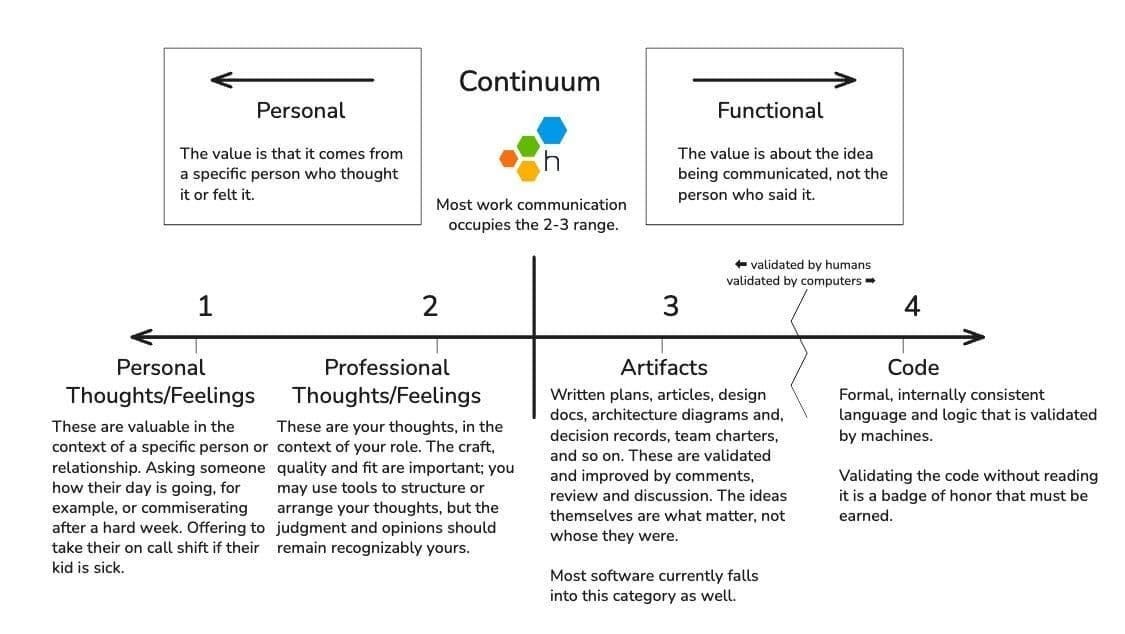
Sometimes, yes, the quality of the work is all that matters. If you and I are collaborating on a document or a diff, all our collective comments and edits are in shared service of making the ideas better. It isn’t about whose idea it was or which tools we used, we are just iterating and improving until it’s as good as we can make it. The use of AI here is just another tool, one of many. In these situations, it’s appropriate to be ruthlessly outcome-oriented.

Other times, the value of a piece of writing derives from the fact that a particular person said it, thought it or felt it, or its value is grounded in your relationship. Why do you care more about what your skip level says about your performance than you would care about reading the same advice in a book? Likely because this is someone you know and respect, someone with influence over your career prospects, someone who knows what you’re capable of and has a vested interest in helping you succeed. In these circumstances, people expect to hear your voice; if they don’t, they may invent all kinds of terrifying reasons why.
There are plenty of messy situations in the middle where objective and subjective overlap, but people are usually crystal clear on what it is they want out of any given interaction.
When I started talking to my coworkers, trying to figure out why they were so angry and frustrated all the time, one thing I heard over and over was, “I asked for my colleague’s opinion, and they sent me back a Claude snippet. I wanted to know what THEY THOUGHT.” When someone wants your opinion, AI generated text registers as a violation.
Another common source of friction was performance reviews. “My performance review was obviously written by ChatGPT. Did my manager even read it, or just push a button and spit it out? What are they even there for, if they aren’t even writing my reviews?” We encourage our managers to use AI to develop systems that help them become better managers, but this is a clear risk of using AI to aid in the writing or editing of reviews: if your voice is lost in the process, it may destroy trust between you.
I have a longer explanation of the four points — personal opinion, professional opinion, artifacts, code — at the Honeycomb blog, and I discuss more of these examples in depth, so I’m not going to recap it all here.

The more any interaction is personal or relational, the more the use of AI in that context tends to cheapen it and degrade trust, unless AI has been specifically invited into that relational context. If you’re expecting a human-to-human interaction, or if you’re specifically requesting a personal response, and what you get back seems like it was pasted from a chatbot, it can be intensely alienating and angering. Even — yes — dehumanizing.
I think this is why I went from finding AI generated text inoffensive to rage-inducing in such short order. I don’t get mad when people use AI to outbound to me (or maybe I should say, I don’t get madder), but when someone writes to introduce themselves or ask for some of my time to review their startup or whatever, I get furious. You’re reaching out to me, human to human, using slop? You can’t even be bothered to write your own “hello”? Fuck you.
Or if someone engages with one of my posts and asks questions, but they’re using AI-generated slop, then I get mad because they’re wasting my time. I’ve engaged with enough slop arguments to know there’s no there there. I don’t know which parts are coming from them and which parts are just meaningless slop.
If I’m giving someone I don’t know some of my scarce and valuable time, I at least want to know I’m giving time to them and their problems, not chasing some meaningless robot effluvia, as I have done far too many times before.
People always say, “oh, but those were MY ideas, I was only getting AI to help me format them”. In my experience, people vastly overestimate how much comes from them and underestimate how much comes from the AI. And anyway, all I have to go on is the signal I have.

This is also why I don’t want to spend time reading any blog posts or newsletters or social media posts written by AI. I don’t care what the AI vomits forth. I have an AI of my own, I can read any time that I want. If I’m reading someone else, I want to know that it’s their thoughts. AI slop isn’t a perfect proxy, but it’s a decent weeder. Besides, aesthetically, it’s just so, so, so bad. I value good writing more than ever these days.
AI is not magic. AI is just a tool, and we should use it anywhere and everywhere we can to do better work, faster, and deliver better outcomes for our users.
But companies, too, are more than one thing.
Every company exists to deliver great outcomes for their users and returns for their stakeholders. But every company is also a collective of people who have come together to achieve a lofty goal, something larger than they could have individually achieved. Ideally, these goals are in harmony.
Relationships matter. A respectful environment matters too. And whereas lines of code are indifferent to their origin, and can be validated by harnesses and tests, people are intensely attuned to the language people use with them. Relationship maintenance cannot be automated.
Yes, AI is just software. But it is special in one way: the slick, sycophantic, uncanny valleyness of the way it communicates. Human-like, but not human, which is somehow vastly more alienating than messages that are plainly automated. This is why communication that sounds like AI is so degrading to trust. We all know how easy it is to have the machine spit out some bullshit on our behalf, and we don’t want it done to us.
This means that humans who want to use it for interpersonal interactions will need to work hard to compensate for the loss of trust it engenders. It can be done — it’s not impossible. But it will not work to simply deny this effect and shove AI-generated happy birthdays and performance reviews down everyone’s throats. Not in 2026.

I’m not claiming that this personal/subjective vs functional/objective scale represents some universal truth, or that all companies should adopt guidelines like this one. But I also don’t think I’m alone in feeling this way. And I think most companies would benefit from writing down their expectations for how people should communicate with each other right now.
This is why we invested so much energy into writing down our AI norms and values. (If you haven’t been following the series, it’s all up now: How We Do Business, AI for Honeycomb Engineering, and AI Norms and Values.)
A lot of things about communication that used to be clear (like “this was written by a person”), no longer are. And a lot of hurt feelings, anger, and frustration are roiling about in the breach. Old norms no longer apply, and new norms are not yet broadly developed or agreed upon.
At times like these, having an agreed-upon convention or standard, any convention or standard, can really help.