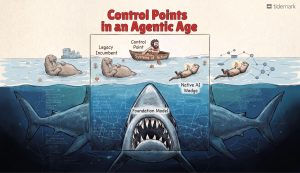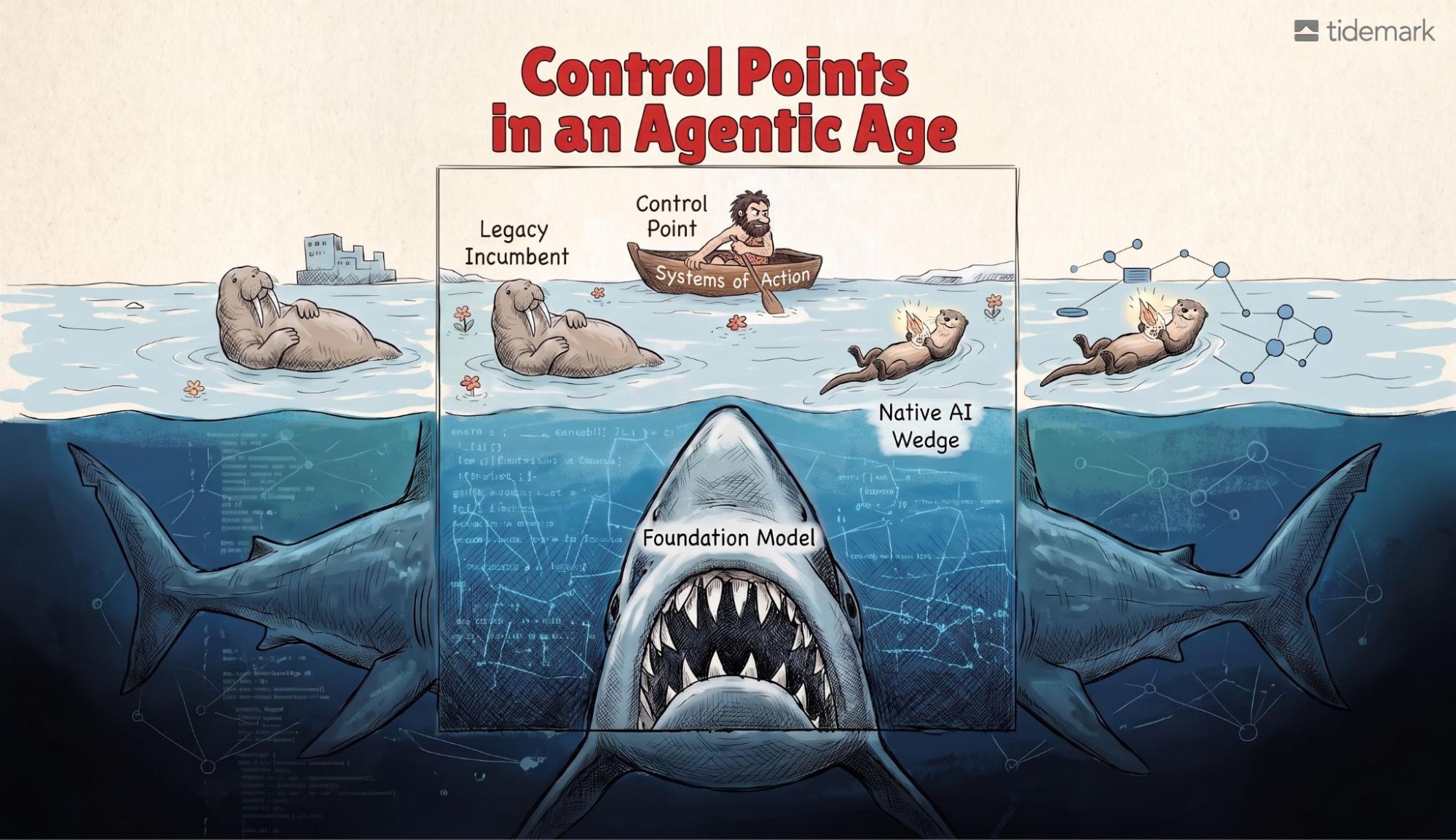
Investors, in their infinite wisdom, have declared the application layer dead. Control Point incumbents and Native AI challengers alike are chum in the water for the “Great White Shark” — Foundation Models — coming up the stack. The investor consensus has spoken! Momentum-money and mercenary talent are gone. Applications are dead!
We think differently.
Yes, AI is magic. It is pushing the technological frontier faster than anything I have seen. But intelligence alone doesn’t book the revenue, chase the invoice, or file the compliance report. AI needs an application layer to bring it to life for customers.
Outside of software development, that application layer largely doesn’t exist today. And in most industries, the Foundation Models aren’t likely to build it.
So in most industries, the application layer — the System of Action — is there for the taking. For incumbent vertical SaaS Control Points and Native AI challengers alike.
But getting there takes product focus and engineering excellence. And application companies now need to learn to think like infrastructure companies to provide the agents the scaffolding to run reliably and get better over time.
Not everyone will make it.
Part 4 is an argument for why customers need an application layer to “do the work,” why the Foundation Models won’t build it in most markets, and the size of the System of Action prize.
In Part 5, we share a framework for how to build the System of Action, including separate “race plans” for Control Point incumbents and Native AI challengers, and some war-gaming exercises that we use with our portfolio.
We’re keeping Part 5 for portfolio companies and operators, and we’ll be going deeper on both sets of ideas at Collective Live in San Francisco on October 21-22, 2026.
Excited to hear what we got wrong or missed.
System of Action & Doing the Work
AI allows non-determinism, and non-determinism applied recursively approximates reasoning. Run it over a long enough duration and it starts to approach thinking. That alone would be interesting. What makes it consequential is the second half: given data, given context, and given the permission to trigger tools, AI can do work in the real world. That is the frontier shift.
So who does that work? The model can only do part of it. A job is a bundle of tasks: some need reasoning, some need to run the same way every time, and some still need a person.
A System of Action is what you get when the AI directs all three. It does the thinking, then reaches for the tools — your workflows, your data, your permissions — to run the deterministic parts, and routes to a human the work that only a human should do. Agents decide, act, produce the output; a learning loop turns what actually happened in the world into a better agent next time.
Your Control Point holds those tools and waits for a person to pick them up. A System of Action does the thinking, picks them up itself, and pulls in the human when the job needs one. That’s what ”doing the work” means — and why the model alone can’t finish it.
We’re seeing this in the real world. We’re seeing that AI needs an application layer to deliver value.
MIT’s Project NANDA put the number on it in The GenAI Divide: State of AI in Business 2025 — 95% of organizations getting zero return on $30–40 billion of enterprise GenAI investment. Their diagnosis wasn’t model quality or regulation. It was learning — tools that don’t retain context and don’t improve from feedback. Only about 5% of integrated pilots were extracting real value.
OpenAI’s own The state of enterprise AI, published in December 2025, says the quiet part plainly. Roughly one in four enterprises still hadn’t connected their AI to internal data — which, in their words, limits value dramatically. And their list of what separates the leaders from everyone else is not a list about models: workflow standardization, data readiness, continuous evaluation systems, executive sponsorship, change management. The work is in everything wrapped around the intelligence.
Anthropic’s June 2026 write-up, How Anthropic enables self-service data analytics with Claude, is the most useful of the three, because it’s an engineering post-mortem rather than a market study. Without hand-built skills, Claude’s accuracy on analytics questions didn’t exceed 21%. With skills, accuracy hit 95% — and then drifted to 65% within a month, until they started treating it as ongoing engineering rather than a launch. Their own summary of the failure mode is the best one-line case for an application layer I’ve read: “an agent that doesn’t understand your business will answer what the user asked, but not what they meant.” That gap is the application layer.
If you look past the accuracy numbers to the process requirements, someone inside the business has to own what the source of truth is for every entity. Someone has to own the definition of revenue recognition and defend it. Someone has to write the human definitions, because you cannot automate your way out of definition-writing. Anthropic tried bootstrapping the semantic layer and got plausible-looking definitions that encoded the exact ambiguities they were trying to remove.
To be clear: we are not saying AI and agents don’t work. In fact, we’ve seen firsthand how it’s transformed our business at Tidemark. But we’ve done the hard yards ourselves — enabling our tools and data, codifying our semantics, taxonomies, and processes, and building a harness for specific outputs and predictable execution.
It has transformed how we do work, but it was also a pain in the ass.
Now ask yourself what auto repair or HVAC shop is going to take that on. Or which 12-person accounting firm has a partner who is going to build and maintain an ontology of their firm and its clients (not to mention police their peers when they fail to adhere to the ontology). They don’t, and they never will. It’s a pain in the ass and it is nobody’s job.
Turns out many of the largest enterprises aren’t excited to take this on either. Consider the Foundation Models’ investment in services organizations. Actions speak louder than any study. Collectively, the Foundation Models have committed roughly $10 billion to buying and building services companies to do it for their customers. OpenAI alone has raised $4 billion for the OpenAI Deployment Company and its acquisition of Tomoro, staffing it with forward-deployed engineers from day one. Anthropic stood up Ode with Anthropic alongside Blackstone, Hellman & Friedman, and Goldman Sachs, aimed squarely at private-equity-owned businesses. When the model makers hire armies of humans to make the models work inside real businesses, they are telling you what the job requires: it requires an application layer!
This is your opening. As a Control Point incumbent or Native AI challenger, you can do it for them. You can build your customers the application layer required for AI to create value in the enterprise. And you have more right to do it than anyone, because you often had to solve those exact problems to build your product in the first place.
Why the Labs Won’t Be the Application Layer for All Industries
The Foundation Models have built much of the application layer for software development. Code is their home turf: public training data, verifiable output. And the labs are software developers building for software developers, in one of the biggest software markets in the world.
But most of the economy doesn’t look like software development, and in most industries the application layer is still very much undecided. So where else will the labs play?
Ask four questions:
- Is the prize big enough to make their roadmap?
- Does the technology have what it needs to solve the problem? Pre-training data to learn from, outcomes you can verify?
- Will the Foundation Models build the best product for the whole job, including the deterministic, unglamorous majority of the job, and carry the liability when an agent acts?
- And will your customers change how they work?
Software development answered yes to all four, and the labs built the best product for developers. Ask the same four questions about dental practices, accounting firms, freight brokerages, and title companies. And where all four answers are yes, ask whether the Foundation Model will have the interest and tenacity to build the best product for the specific industry.
.png)
Foundation Models, even with infinite capital, can’t build every vertical at once. They will concentrate on the biggest prizes. Attacking software development made all the sense in the world. How far down the priority list is HVAC operating software?
Foundation Models will also concentrate where AI works well — where pre-training data is available, where outcomes are verifiable, where a wrong answer is cheap. But what about the rest? For the rest, the right tool is deterministic software, classic ML, or just plain rules.
Customers aren’t paying for the AI parts. They’re paying to have the whole job done. If you can’t do the entire task mix, you can’t “do the work.” Will the Labs build everything a customer needs to do the whole job if it runs counter to their pitch that AI specifically eats everything?
Finishing the job also invariably means dealing with edge cases. Take Watsco, the largest HVAC distributor in North America1. When the EPA’s refrigerant rules forced the A2L transition, Watsco had to add over 10,000 new “regulatory match-ups” — each one with dimensions, capacities, bills of material, warranty information — to cover over 50% of the products it sells. Regulatory match-ups are no joke — use the wrong SKU and you’re arguing with a manufacturer about whether the warranty still covers a big honking piece of capital equipment.
Building for each vertical means learning an industry from scratch — its language, its ontologies, its regulations, its commercial practices, its workflows, and its edge cases. Are researchers at the Foundation Models fired up to code changing refrigerant rules? I doubt it. None of them joined to relabel refrigerants.
Finally, the Foundation Models can only move as fast as customers want to adopt. Most industries aren’t as change-seeking as the Valley. Disruption and behavior change are a hassle, not a status to be celebrated. The dentist who has run the same front-office routine for 11 years is not looking for a new way to work; she is looking for Thursday to go smoothly. Change costs her chair time, retraining, and a week of rework.
You have a moment in time to build the agentic application layer for your customers, ahead of the industry and ahead of the Foundation Models. Do not read that as safety. Read it as a window.
Somebody is going to become the application layer — the System of Action — in your market. If it isn’t you, you’ve got problems.
Customers Want AI Embedded in How They Already Work
The good news is that customers are telling us where they want the application layer built. Echoing OpenAI’s findings: they want AI embedded in their workflows, working on their data, in UIs they already use.
In our own research, when we surveyed vertical software buyers in January 2025, 83% said they would switch to a Control Point agent that was 80% as effective. We got the same result when we ran the survey again in April 2026. Customers want AI embedded in the system they already run their business on. They do not want another login or another vendor.
%20(2).png)
The 10x System of Action Opportunity
If you make the transition, if you deliver this AI magic to your customers, what’s that worth?
Turns out it’s worth far more than the historical software opportunity alone.
Tidemark Fellow Ershad Jamil, former Chief Growth Officer at ServiceTitan, and I sized it in Multi-Product, Multiple Choices: How to Determine Product Priorities. Looking at the P&L of a representative small business: labor is roughly half of everything it spends. Software is 5%.
The labor automation opportunity is roughly 10x larger than the software opportunity!
.png)
This isn’t just theory — we’re starting to see it in the marketplace.
“Ironically, before long-duration agents, vertical AIs were stuck in co-pilot mode. Now you have vertical AIs that can actually take action and do work. You have a vertical AI booking a $7M deal with a customer who never paid more than $500K for all software tools combined.”
— Anthropic insider
Sit with that a second — the System of Action is earning 10x+ what all the other software vendors at that customer earn combined!
That’s not just 10x+ revenue. It’s 10x+ TAM, 10x+ the dollars to fund CAC, 10x+ the dollars to fund the next agent. You have 10x+ the relationship, 10x+ the sway, 10x+ the clout.
——-
1Watsco public filings 2025