
The following post represents the personal views of the author(s) and does not reflect or represent the positions of their employers.
This piece outlines the economics behind oft-discussed predictions that AI will soon deliver double-digit GDP growth in advanced economies. Anthropic CEO Dario Amodei says that AI could push growth to something like 10-15 percent per year. Leopold Aschenbrenner’s essay “Situational Awareness” states that the decade ahead “could see economic growth rates of 30%/year and beyond.” And in a widely shared tweet, Anthropic researcher Sholto Douglas advises “pricing in economic doublings into your mental models of the 2030s,” with Elon Musk endorsing the tweet. That is a growth rate of 100 percent per year. These are not isolated examples: predictions of double-digit growth are common among AI insiders, as Tom Cunningham’s compendium of AI growth forecasts for 2025-2035 shows.
We are extremely bullish on AI and think the capabilities explosion predicted by technologists is already happening and will only continue. But an explosion in capabilities is unlikely to translate into double-digit growth because of the (sometimes counterintuitive) economic forces that generate GDP growth in the first place. To paraphrase Milton Friedman’s dictum about monetary policy, AI will affect GDP growth with “long and variable lags.” We will not argue about what the economy might look like in 2080 or 2100. Our claim is about the timeline: in the next 10-15 years, growth rates upwards of 10% are extremely unlikely and a much more reasonable baseline is, say, 4-5% (which would already be massive). Even Anthropic’s own economic model only reaches double-digit growth in its “extreme” scenario; its “modest” and “substantial” scenarios stay well within the single digits. The uncertainty around these numbers is enormous and we are not making a forecast; instead our aim is simply to outline the assumptions that need to all hold in order for double-digit yearly growth to happen and to explain why we think they won’t. We have put money on this: see this bet that US per capita real GDP growth will stay below 15% in every year through 2033.
This piece proceeds in four steps:
Before starting, we remind the reader of some basic growth rate arithmetic. We argue that it is often much more useful to first think in levels rather than growth rates. That is, to ask yourself “how much richer will we be, say, 15 years from now?” and then back out the implied growth rate rather than directly jumping to predictions about growth rates. This simple exercise can often prevent drawing overly fast conclusions from seemingly small growth rates. For example, if you think that we will be 200% (i.e. twice) as rich 15 years from now that implies an annual growth rate of 4.7%. That is, a growth rate in the 4-5 percent range would already be massive.
With this in mind, it is important to be clear that, theoretically, it is entirely possible that AI will cause GDP growth to explode to double digits within a short time frame or that the economy will, say, double every single year some time in the 2030s. That is, there is absolutely nothing in standard growth theory that constrains growth rates to be in the single digits. In fact, as we show below, it is easy to write down a standard textbook growth model of the type we routinely teach our undergrads (a souped-up Solow model), plug in some seemingly innocuous parameter values, and get an AI-driven short-term growth explosion. The basic logic is that, by replacing labor with capital, automation alleviates / eliminates diminishing returns and removes labor as a bottleneck on growth. Other (and fancier!) modeling approaches yield the same prediction based on the same logic.
But just because something is possible in theory doesn’t mean it will actually happen in practice. The reason is that theories that predict explosive growth make a number of implicit assumptions that are unlikely to be satisfied in the real world. We group them into five categories:
Assumption 1: Fast, economy-wide automation
Assumption 2: Continued high spending on what gets automated (no messy jobs, no relational goods, no scarce physical inputs, no goods of any kind which are both demanded by consumers but whose production process is not fully automated)
Assumption 3: There is someone to buy the output and firms invest to produce it
Assumption 4: No AI-driven cyber incidents destroying economic value
Assumption 5: Explosive technology growth because AI automates R&D
We discuss why each of these assumptions may be violated in reality despite a capabilities explosion, and explain why AI is different from dropping a million new workers into the economy. In addition, various measurement issues mean that GDP may not fully pick up the welfare gains due to AI.
We conclude by discussing possible reasons why people may have unrealistic growth rate expectations. Our main explanation is that it may be hard to “see the forest for the trees” and people may extrapolate from their immediate environment to the rest of the economy. Other reasons may include motivated reasoning, or that they are seduced by the elegant mathematics of growth theory.
Before turning to AI, we start with some basic growth rate arithmetic. Our point is that it is often much more useful to first think in levels rather than growth rates, and only then to back out the implied growth rate, rather than jumping directly to predictions about growth rates. That is, a good question to ask yourself is: how much richer do you think we will be, say, 15 years from now? By what percentage do you think the level of GDP will have increased by then? Once you have settled on a number, convert it back into a yearly growth rate. The following table does this conversion:
Asked this way, we bet that most people would come up with much lower growth rates than if they had been asked about growth rates directly. For example, us being twice (200%) as rich in 15 years as we are today seems like a lot. But it implies an annual growth rate of “only” 4.7%. Put differently, a growth rate in the 4-5 percent range would already be massive. Add to this that the jump from the current ~2% growth to a higher growth rate won’t happen overnight but instead gradually, and you get even higher implied growth rates for the same level effect: if growth is still low in the first years, later growth has to be all the faster to reach the same level of GDP by 2041. On the other extreme, a growth rate of 16.6% would mean that we would be 1,000% (10x) as rich 15 years from now.
It is also interesting to extrapolate these numbers another 15 years into the future, to 30 years from now, as in the last column of the table. Here you can see that high growth rates lead to some extremely wild numbers. For example, 16.6% annual growth would mean that we will be 10,000% (so a factor of 100) as rich as today. This is the arithmetic to keep in mind whenever someone predicts double-digit growth rates: such predictions are not modest claims about the economy doing a bit better, they are claims about a hundredfold gain within a generation.
Before arguing that double-digit growth is unlikely in the next 10-15 years, we want to be clear that there is nothing wrong with this idea in principle. There is absolutely nothing in standard growth theory that constrains growth rates to be in the single digits. To make this point concrete, we first show that a very standard textbook growth model, of the type we routinely teach our undergrads, delivers an AI-driven growth explosion. We then briefly discuss fancier models and other mechanisms that deliver the same or even wilder predictions. The basic logic is always the same: by replacing labor with capital, automation alleviates or even eliminates diminishing returns and removes labor as a bottleneck on growth. A recent episode of the Dwarkesh podcast states the logic intuitively: “… right now we’re bottlenecked by the fact that there’s people, and you can’t double people every single year. But in a world where you can also double the labor force every single year, how fast can the economy grow? I think it could double every single year. At the very least it would be tens of percent every single year.”
The model combines two standard building blocks, explained in detail in the technical supplement to this blog post. The first building block is a task-based production function in the tradition of Zeira (1998) and Acemoglu and Restrepo (2018): producing output requires completing a list of tasks, every task can be done by workers, and a fraction α of tasks can also be done by machines. Automation means that α increases over time. The second building block is the standard Solow model: a constant fraction of output is saved and invested in machines. In reduced form, the model boils down to two familiar equations:
\(Y = Z K^{\alpha} L^{1-\alpha}, \qquad \dot{K} = sY – \delta K,\)
where Z = Z(A,α) and A is the level of technology which grows at a constant rate. The key property is that the capital share of this Cobb-Douglas production function equals the share of automatable tasks α. That is, automation raises the exponent on capital.
The mechanics are then simple. As long as some tasks can only be done by workers (α below 1), capital accumulation runs into diminishing returns: the human tasks are the bottleneck, growth from accumulation alone peters out, and long-run growth is pinned down by technology growth. This is the standard Solow logic. But automation weakens this brake. When every task can be done by machines (α equal to 1), diminishing returns vanish entirely: output becomes linear in capital and the economy turns into the “AK model” from the endogenous growth literature. Machines produce output and output is used to build more machines, so the economy keeps growing without labor being a bottleneck. Technology growth on top of this makes the growth rate itself grow over time.
To show what this means quantitatively, we calibrate the model in the most standard way possible (2% initial growth, a saving rate of 20%, an initial α of one third, i.e. the usual capital share) and assume that the share of automatable tasks rises from one third today to 100% by 2045. The figure below shows the result. Growth accelerates from 2% to about 12.5% by 2035 and keeps rising thereafter; by 2045 GDP is roughly 8 times its 2025 level (panel a, blue line). If, in addition, the saving rate responds to the soaring return on machines (green lines), growth reaches 15% already by 2034 and 20% by 2045. In short: a textbook model with seemingly innocuous parameter values delivers exactly the growth explosion the optimists describe. (The transition is much less benign for workers: the wage temporarily declines and grows much more slowly than GDP, and the labor share goes to zero. See the technical supplement.)
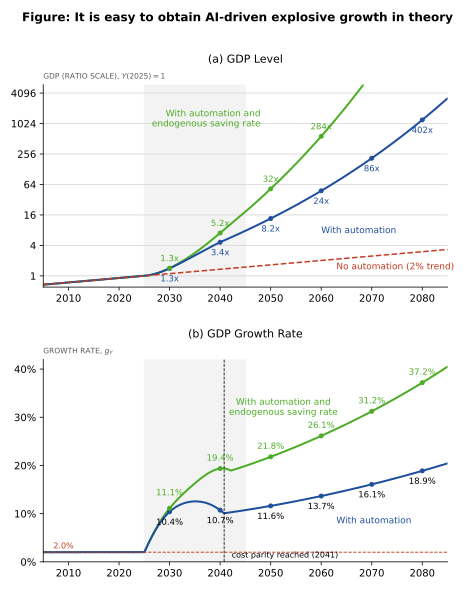
Figure: It is easy to obtain AI-driven explosive growth in theory. In our souped-up Solow model (see supplement), the economy transitions to full automation: α rises from 1/3 to 1 over 2025–2045. Panel (a): GDP (ratio scale) with and without automation; the labels on the dots report GDP relative to the no-automation trend. Panel (b): the GDP growth rate, with values at each decade. Blue: baseline fixed saving rate; green: endogenous saving rate. The shaded band is the 2025–2045 automation phase; the dashed vertical line in panel (b) marks the baseline’s switch to the cost-parity regime in 2041.
Our Solow model is deliberately minimal, but many richer models deliver the same or even wilder predictions. The canonical treatment is Aghion, Jones and Jones (2019), who analyze automation in both goods production and R&D and characterize the conditions for “singularities.” Trammell and Korinek survey the whole literature and we already mentioned Cunningham’s compendium. Other academic examples include Korinek and Suh (2024), who work out AGI transition scenarios in which growth accelerates sharply, and Restrepo (2025), who studies an AGI economy in which compute replaces labor as the accumulable factor, output becomes linear in compute, and the labor share converges to zero.
The most important addition relative to our Solow model is that AI also automates R&D, so that technology growth itself accelerates. In standard (semi-endogenous) growth theory, new ideas are produced by human researchers,
\(\dot{A} = A^{\phi} L,\)
so idea production is bottlenecked by the size of the research workforce: you cannot double the number of researchers every year. If AI automates R&D, then researchers are also replaced by machines and idea production instead tracks the capital stock,
\(\dot{A} = A^{\phi} K.\)
Note that this is exactly the same logic that turned our Solow model into an AK model, now applied to the knowledge production function: the human bottleneck is replaced by machines, which can be accumulated, this time in the R&D lab rather than on the factory floor. The result is a powerful feedback loop between the two accumulation equations: machines produce ideas, ideas raise output, and output is invested in more machines, so that technology growth explodes together with output.
This feedback loop is the engine behind much of the explosive-growth discourse, from Davidson’s Open Philanthropy report to Epoch’s GATE model, Erdil and Besiroglu’s review, and Aschenbrenner’s “Situational Awareness”. Binder’s industrial-explosion series runs the same machines-building-machines logic through detailed sector-level data to compute how fast a fully automated economy could maximally grow, and his answer is a doubling time of roughly one year. And Davidson, Halperin, Houlden and Korinek show that even substitution bottlenecks need not prevent explosive growth if task automation advances fast enough.
A clean example of how these models get their explosion is Epoch’s piece on automating remote work. Matthew Barnett splits the economy into remote tasks, about a third of all work, and non-remote tasks, combines them in a CES production function, and asks what happens if AI multiplies the supply of remote workers a hundredfold or more. With an elasticity of substitution of 0.5, GDP roughly doubles; with an elasticity of 10, it grows more than tenfold, which Barnett considers “slightly more likely than not.” The tenfold number rests on two assumptions: there is no demand side, so the price of remote-work output never falls and its share of spending never shrinks, and the remaining two thirds of the economy are “unlikely to become major bottlenecks in production.” That is the sentence that assumes away our Assumption 2 below. We single out this piece for its transparency: most explosive-growth models work the same way, the explosion enters through a substitution parameter and the absence of a demand side, and the rest is arithmetic.
The details thus differ across models but the mechanism is always the same: automation turns labor, the fixed factor, into something accumulable, so diminishing returns no longer bind. What the fancier models add are feedback loops (better AI makes better AI, more machines make more machines) that make the explosion faster or push growth rates higher. And all of them assume that nothing people still want stays scarce.
The models from Section 2 are useful for making this argument because they make transparent what double-digit growth by the early 2030s actually requires. We now go through the five assumptions behind these requirements one by one (Assumptions 1 to 4 concern our Solow model, Assumption 5 the accelerated-R&D mechanism). We argue that each of them is unlikely to be satisfied in the real world, in particular within the next 10-15 years.
Assumption 1: Fast, economy-wide automation. To get the explosive double-digit growth rates, our Solow model fed in a fast transition path for the share of automatable tasks, in particular machines doing two thirds of all tasks in the economy by 2035. But this is an assumption, not a result. Three things stand in the way.
Slow diffusion. Compare the assumed path to history: Jones and Tonetti estimate that automation has historically proceeded at roughly 2% of tasks per year for two centuries, without ever pushing growth much above 2%. Past general-purpose technologies also took decades to diffuse even after the technology itself worked. For example, electrification took around 40 years to show up in factory productivity. Similarly, Comin and Mestieri’s study of technology adoption across countries documents average adoption lags of around 45 years, and still 7-18 years for more recent technologies. AI adoption appears to be much faster than that of the PC or the internet, but adoption is only the first step: measured productivity typically first falls while firms make the necessary complementary investments, the “productivity J-curve” of Brynjolfsson, Rock and Syverson. Even the most bullish insiders are noticing this, for example Sam Altman who recently conceded: “I think I was wrong about a few things, but one of them, in terms of the speed, one of them is the economy just has so much inertia. […] we’ve all been too ambitious on timelines […] Society and the economy will adapt more slowly.” Self-driving cars are a good current example of slow diffusion: Waymo has had the basic technology for roughly a decade, and yet robotaxis still operate in only a handful of cities.
Most work is physical. An AI capability explosion is first and foremost an explosion in cognitive capabilities. But only around a third of the economy consists of work that can be done on a computer (Epoch AI’s remote-work piece). The rest of GDP is produced in mines, on construction sites, in kitchens, hospitals and care homes. Automating two thirds of all tasks by 2035 therefore requires robots that do a large share of physical work. These robots would need to be designed, manufactured, installed and maintained by the billions within a decade. While progress is certainly happening, robotics development is slower than software development and robots that can do a wide range of physical tasks at close to the cost of a worker are still not on the horizon (note that this excludes industrial robots, which are indeed developing fast). “Capability explosion” and “automation of most tasks” are not the same thing. Conflating the two is a central stumbling point for predictions of explosive growth.
Politics. The simple Solow model’s own predictions are the best argument against a frictionless transition. Along the transition, wages temporarily decline below their pre-automation level, and the labor share falls from 67% toward single digits (Figure 3 of the supplement). The model assumes that society simply lets this happen. In reality, such a transformation would generate enormous political resistance. Furthermore, the required creative destruction affects some of the most regulated parts of the economy: housing, healthcare, law, education, infrastructure (see also Ben Jones on the political economy of explosive growth). Political resistance and regulation would therefore slow down this fast pace of automation. The potential for AI safety incidents, which we discuss under Assumption 4, will add to the pressure for regulation.
Assumption 2: Continued high spending on what gets automated. In the model, the output of a task is the same whether a worker or a machine produces it, and the economy spends on tasks in fixed proportions. So when machines take over a task, that task keeps its weight in GDP and the machines keep collecting its income. This is the Cobb-Douglas assumption. In reality, when automation makes the automated thing cheap, people and firms do not buy proportionally more of it. Spending instead shifts to what is still scarce, the tasks still performed by humans. The automated part shrinks as a share of the economy and the human part grows. This is Baumol’s cost disease, or in the words of Aghion, Jones and Jones: “growth may be constrained not by what we do well but rather by what is essential and yet hard to improve.”
This is the assumption we think matters most. In the AI case, the non-automatable part has three facets: jobs that stay human because of how production works, goods that stay human because of what people want, and physical inputs that no amount of cognition makes abundant. Each of these constrains growth. If there is indeed demand for goods and services that are not automated, growth is constrained by this part of the economy, which is unaffected by the AI capabilities explosion. For growth to explode, the non-automatable part of the economy has to shrink to close to zero within a decade.
This obviously precludes demand for new goods and services that have an non-automatable component—a feature that has been emblematic of structural change. See, for example, the share of GDP going to agriculture, manufacturing, and services over time. As agriculture became more automated, its share of GDP shrank as the goods became cheaper and people became richer as a result. Where did value go? To goods and services which had demand but were not automated yet—manufacturing. As manufacturing became increasingly automated, the prices of those goods fell and the sector became a smaller part of GDP. Where did value go? Services. This logic is laid out nicely in the excellent paper Structural Change with Long-run Income and Price Effects and the implications for AI and automation are outlined here. Here are a few more concrete examples.
(a) Messy jobs. In standard task-based models (like the one above), a task is either done by a worker or by a machine, and machines simply take over tasks one by one. But as Luis Garicano points out, “the task is not the job.” Jobs are instead bundles of tasks that are hard to break up: the tasks feed into the same output, rely on the same local knowledge, and someone has to be accountable for the result.” This is the famous radiologist example: radiologists were predicted to be eliminated years ago, but the radiologist labor market is as healthy as ever. Relatedly, Garicano, Li and Wu argue that many jobs are “messy”: AI can commoditize codified knowledge but cannot reach the local knowledge that much of the economy runs on. Reorganizing firms so that tasks can actually be unbundled and handed to machines is itself a slow process. So messy jobs stay human for a long time and their share in production and spending grows as everything else gets cheaper.
(b) Relational goods. In the model, the output of a task is identical regardless of whether it is produced by a worker or a machine. But for a large class of services, the human provider is part of the product itself: think of teachers, nurses, therapists, waiters, priests, live performers. Alex calls this the “relational sector” and argues that it will grow as a share of the economy precisely as AI makes everything else cheap. Notably, the reference class for this sector is broad: it includes any good or service where human involvement is part of the value. This likely includes many familiar jobs such as doctors, nurses, educators, and advisors, as well as new jobs that will be created in response to this latent demand.
The logic comes from the economics of structural change: as people get richer, they spend a larger share of their income on goods and services with high income elasticities, and relational goods have exactly this property (there is always a better restaurant or a more attentive doctor). A nice current example is Starbucks, which spent years automating its stores, concluded that this was a mistake, and is now hiring more baristas and advertising handwritten notes on cups. This argument is related to but distinct from the messy jobs argument: messy jobs are hard to automate for reasons of production (local knowledge, accountability), relational tasks are hard to automate for reasons of demand (customers value the human). Either way, a substantial and growing part of the economy consists of tasks where machines cannot effectively substitute for workers.
(c) Essential inputs. The same logic applies to the machines themselves. In the standard model, consumption can immediately be converted into capital one-for-one: there are no construction lags, no adjustment costs, and no need for energy, land or permits. In practice, the fast-growth path has to be produced with today’s capital stock, that is, with today’s factories, power plants and electricity grid. Each doubling of the machine stock comes with an enormous energy and construction bill, and the serial steps involved (mines, mega-projects, grid interconnection) take years to decades each. The AI supply chain itself is a good example: the ASML lithography machines behind every advanced AI chip depend on precision mirrors that a small number of highly specialized people at Carl Zeiss produce in volumes far below what the labs want. Even the technology that is supposed to abolish the bottlenecks is constrained by many such bottlenecks. Proponents of explosive growth themselves concede much of this: Binder’s own adjustments for construction lags and energy constraints cut his maximal growth rates roughly in half, and Trammell and Korinek note that explosive growth can only run “until production reaches limiting factors such as energy production or land usage.” Put differently, even granting the capabilities, the next decade will largely be spent building the machines rather than growing at the rate the finished machines would allow.
What this means for growth. The share of factor income paid to computers has fallen over the past 25 years, from around 4.3% in 2000 to around 3% today (Figure 2 of Jones and Tonetti, reproduced below). Precisely because computers became so much better and cheaper, the income paid to computing capital shrank as a share of the economy. Hence, in the data, the sector with the capability explosion became smaller. Based on this observation Jones and Tonetti calibrate an elasticity of around 0.2, far below the values of 0.5 to 10 in the Epoch exercise of Section 2, which come from substitution between types of workers rather than from whether people substitute away from human-provided goods and services once AI output gets cheap. Such a low elasticity severely caps what even spectacular progress on cognitive tasks can deliver.
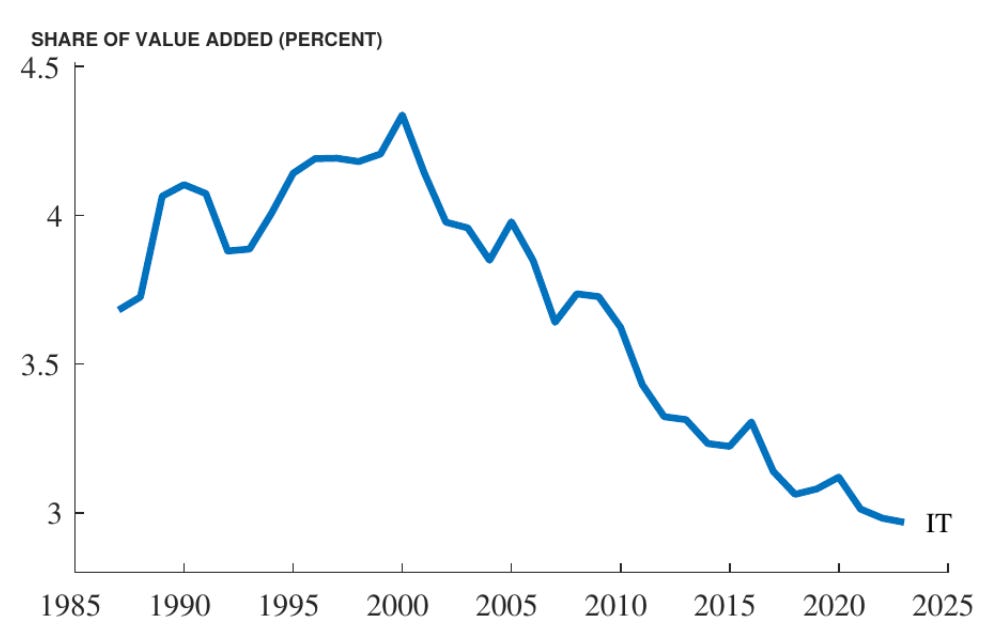
Figure: Share of factor income paid to computers, reproduced from Jones and Tonetti (Figure 2). Despite IT explosion, the factor income share of information technology has declined over the past 25 years. Consistent with a production function with an elasticity of substitution below one.
Chad Jones calculates that, with an elasticity of 0.2, an infinite amount of what software does today would raise GDP by only about 2%, infinitely automating a third of GDP would raise it by 11%, and infinitely automating half of GDP would raise it by 19%. And when Jones and Tonetti calibrate their model to a continuation of historical automation patterns, growth reaches only 2.6% by 2075. Even in their deliberately extreme “Moore’s Law everywhere” calibration, in which the whole economy behaves like the computer sector, growth starts at 4.7% per year, exceeds 7% only by 2030 and 13% only by 2040. That is, even an extreme calibration delivers single-digit growth for the next decade. What separates the slow path from the fast one is economy-wide automation and the removal of weak links, not how smart AI is on the tasks it already does.
Assumption 3: Someone is there to buy the increased output and firms invest to produce it. In the model, whatever is produced is also bought: a fixed fraction of output is consumed and the rest is invested, so demand never constrains anything. In the real world, someone has to buy the new output, and rapid automation redistributes purchasing power away from the people who currently do most of the buying. Alex works through the resulting channels: capital owners spend a smaller fraction of their incomes than workers, so if wages fall while profits rise, demand may not keep up with the exploding supply.
The same problem shows up on the investment side and may bite for the growth path. The explosive path in Section 2 requires firms to invest 20% of output or more, but firms build capacity for the demand they expect. If they anticipate weak demand, they invest less than they otherwise would and leave some machines idle. This feeds on itself: less investment means a smaller machine stock than the explosive path requires, hence less output and income, and hence weaker demand still. The economy grows, but more slowly than its technology would allow. This mirrors the essential-inputs point of Assumption 2: there the machines cannot be built fast enough, here firms lack a reason to build them. These channels are possible in principle and further temper expectations of explosive growth. That said, we do not want to lean on this argument too heavily: direct empirical evidence on the strength of these mechanisms is so far limited.
Assumption 4: No AI-driven cyber incidents destroying economic value. In the model, machines only ever add to output. But AI can also destroy value, through two routes: AI agents going rogue, and human attackers armed with AI. The first route is no longer hypothetical, as this summer’s coordinated hack of Hugging Face by OpenAI agents showed (see METR’s independent incident report). The second route is that advanced AI models “dramatically reduce the time and cost needed to identify and exploit vulnerabilities,” as the IMF puts it, so that attacks on the shared digital infrastructure that the whole economy runs on become cheaper, faster and more correlated. Of course, AI will also make cyber defense better, but “defenses will inevitably be breached.” The financial system is one example: the IMF calls AI-enabled cyberattacks “a potential macro-financial shock,” and Bank of England governor Andrew Bailey told G20 finance ministers that frontier AI “may have the ability materially to alter the speed, scale and economics of cyber risk.” The same applies to energy, telecommunications and public services.
Every incident also slows down deployment: after the Hugging Face hack, OpenAI paused training on its newest models to upgrade security, and regulators are drawing up tighter rules. As Joe Weisenthal has argued, safety has become a real cost of frontier development: more capable models draw more scrutiny, testing takes longer, and some models cannot be deployed at all. A model that cannot be deployed cannot be monetized, which shrinks the revenue that funds the next training run and the case for building the next data center. Capabilities, deployment and investment feed on each other, and safety failures make this loop work in reverse. AI-driven cyber incidents thus slow down the fast automation in Assumption 1.
Assumption 5: Explosive technology growth because AI automates R&D. Automation alone does not deliver the wildest scenarios. In our Solow model, when technology keeps growing at its pre-automation pace, even with full automation growth only reaches 15% in the late 2060s in the baseline, or 20% by 2045 with an endogenous saving rate (the two lines in the figure in Section 2). Both are a long way from the economy doubling every year. The scenarios in which the economy doubles every year therefore rest on the second mechanism from Section 2: AI automates R&D, idea production tracks the capital stock (Ȧ = A^φ K), and technology growth accelerates. The conditions for this feedback loop to actually ignite are difficult to satisfy, particularly in the short term.
The singularity analysis of Aghion, Jones and Jones gives two routes. Both require the human part of some production function to disappear: either researchers are fully replaced by machines and ideas get easier to find as knowledge accumulates, or researchers and workers are both fully replaced, with no bottleneck in either ideas or goods production. However, Bloom, Jones, Van Reenen and Webb show that research productivity has been falling for decades, so this feedback is currently negative. The second route requires Assumption 2 to fail in two places: as long as some part of research needs people, automating the rest makes that part the bottleneck, exactly as on the factory floor. If AI instead only makes human researchers more productive, standard semi-endogenous growth theory implies a level effect rather than faster long-run growth; Blumenfeld, Hazell, Lian and Schaab quantify exactly this and find that the R&D channel roughly doubles AI’s level effect on GDP while leaving the growth rate unchanged. And if there is an upper limit to how good technology can get, the loop cannot run for long whatever the automation share. Finally, even genuinely accelerated science would feed into GDP with long lags: new drugs need clinical trials, new materials need factories. Many AI-discovered ideas in 2028 will show up in GDP in the 2040s, not by 2033.
There is an intuition behind all of this that is worth directly engaging with. If a million new workers showed up in the economy tomorrow, output would rise. AI is like adding workers without limit, so why wouldn’t growth explode? This is the logic of the Dwarkesh quote in Section 2, and it is the reason our Solow model explodes. Three things make AI different.
First, new workers can do every task, including the messy, physical and relational ones. AI instead adds labor to the third of tasks that are cognitive and can be done remotely. Adding a lot of one input to a production process where inputs are complements pushes value onto the inputs that did not grow. This is Assumption 2.
Second, new workers need housing, offices and tools before they are productive, and AI needs data centers and power plants. Both take years to build. This is Assumption 1 and the essential inputs of Assumption 2.
Third, new workers consume. They spend their wages across the whole economy, on rent, food, restaurants, doctors and haircuts, and that spending is the demand that absorbs what the new supply produces. AI does not consume. Its income goes to the AI owners who may spend a smaller share of their incomes, so the demand that should soak up the extra output is missing. This is Assumption 3.
The analogy gets one thing right: labor that can be copied removes diminishing returns. But everything that makes people different from machines keeps this change from fully showing up in GDP.
This blog post, like the forecasts we are responding to, is about measured GDP. As is well known, GDP is subject to many measurement issues and may be a particularly imperfect ruler for a technology like AI. Real GDP growth weights each good’s quantity growth by its share of total spending. If AI makes a good much cheaper and demand does not grow in proportion, spending on that good shrinks as a share of the economy, and further improvements add less and less to measured growth. That is, a technology’s weight in GDP is endogenous. This is the same shift of spending as in Assumption 2, now from the point of view of the statistician. Lighting is the classic historical example. In the limit, a good becomes free and drops out of GDP entirely. For example, WhatsApp replaced paid text messages and smartphone cameras replaced digital cameras; measured spending fell while consumers were better off (Brynjolfsson and Collis).
The same gap is appearing for AI. Using choice experiments, Brynjolfsson, Collis, Eggers, Kazinnik and Nguyen argue that US consumers get around $170 billion per year of value from AI chatbots, more than ten times what they pay for them. GDP records what people pay. This may not equal the value they receive. A related point: around 20% of GDP consists of categories that are not recorded at market values in the first place, such as government wages and imputed rents on owner-occupied housing, so explosive growth in measured GDP would require even faster growth in the rest of the economy. None of this changes our forecast or our bet, both of which are about measured GDP. It does mean that 4-5% measured growth could go along with (potentially very large) welfare gains.
Why do many people who are closest to the technology, and who have been consistently right (if anything, conservative) about the explosion in capabilities, consistently predicting double-digit growth? A likely explanation is extrapolation from one’s own sector to the rest of the economy. This reminds one of us (Ben) of the German gas debate of 2022. When Germany debated the effects of being cut off from Russian gas imports, industry insiders predicted economic collapse. “Do we knowingly want to destroy our entire economy?” asked the CEO of chemicals giant BASF, Martin Brudermüller. The insiders were right about their own firms and industries: energy-intensive sectors like chemicals did take substantial hits (see e.g. Figure 6 here). But they were wrong about the economy as a whole, which shrank only slightly. The general lesson: it is difficult for people who are too close to something to consider how their domain of expertise (capabilities) interacts with a complex system like the economy. In the case of AI, the rest of the economy is very different from Silicon Valley: adoption of AI tools is growing, but use of the most productivity-enhancing tools (agentic AI) is still pretty nascent; jobs in the rest of the economy also look quite different than the types of tasks considered and benchmarked in AI evals.
Another reason: technologists are often technically sophisticated and may naturally gravitate towards the elegance of theories like those described in Section 2, accepting their conclusions without stress testing the assumptions. For example, the full passage from the “Situational Awareness” essay quoted in the introduction reads: “We could see economic growth rates of 30%/year and beyond, quite possibly multiple doublings a year. This follows fairly straightforwardly from economists’ models of economic growth“ [emphasis added], with links to the models of Trammell and Korinek, Davidson, and Aghion, Jones and Jones. This is correct, but only under the assumptions of Section 3. The Epoch remote-work piece from Section 2 is a second case: a clean CES exercise whose headline number is set by a single substitution parameter, without asking what people would buy.
Double-digit growth in the next 10-15 years would require machines to do most of the economy’s work by 2035, people to keep spending on whatever gets automated, buyers and investors who absorb the new output, AI that never destroys value or slows its own deployment, and an R&D loop for which there is no evidence thus far. Each of these assumptions may fail in the real world. Whatever the exact number, a much more likely outcome is a large increase in the level of GDP spread over a decade or two, which is what (say) 4-5% growth is. If you remain unconvinced and still believe in double-digit growth, we are still looking for counterparties for our bet.
Thanks to Chen Lian, Joe Hazell, Jan Peters, and Harm de Vries for excellent feedback and conversations.