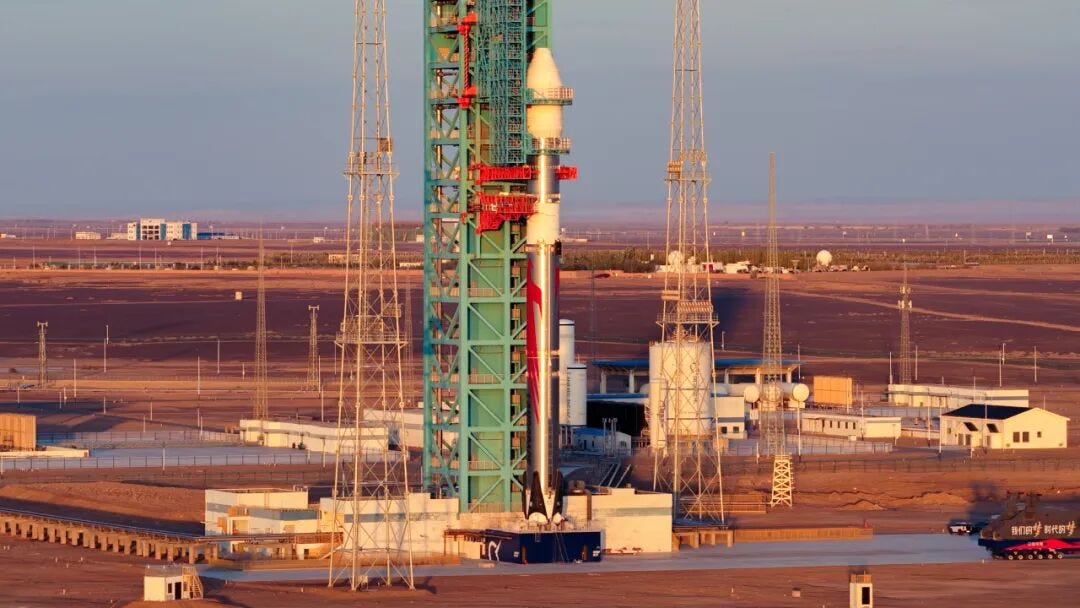
August 19 morning marks a historic peak for China’s commercial space industry.
China’s private rocket company’s Zhuque-3 (ZQ-3), often dubbed the “China’s Falcon 9,” successfully recovered its first stage booster on its second attempt. It might not be as explosive as a first-try success, and it missed out on the glory of being China’s very first booster recovery, but it’s still a seriously impressive achievement. It is land-based, and in a Falcon-9 style, standing on the pad with legs.
Just like the Falcon 9, it uses landing legs for recovery (which visually looks like the launch sequence played in reverse). That said, the Falcon 9 actually had way more early failures before getting it right.
The video clips shows that two minutes and some seconds after the launch, the first-stage booster successfully separated from the second-stage rocket carrying a satellite. Less than ten minutes after launch, the booster, having undergone two retro-propulsion decelerations, slowly landed at a recovery site in Minqin County, Gansu Province, about 390 kilometers away from the launch site.
The size of this rocket are comparable to those of SpaceX’s current workhorse, the Falcon 9, and its overall technological approach is, in a sense, similar to that of Starship, utilizing a stainless steel rocket body and liquid oxygen-methane engines, which could enable it to achieve even lower launch costs than the Falcon 9.
The Zhuque-3 employs a landing-leg recovery method that slightly sacrifices payload capacity, allowing the rockets to be refurbished and relaunched in a shorter time frame, as engineers only need to maintain the rocket itself without having to repair ground recovery equipment.
Aug. 19’s success came after a recovery failure last year.
Now, Commercial spaceflight is currently one of the hottest technology sectors. At present, China has more than 20 rocket companies and over 80 rocket models.
When LandSpace (蓝箭航天) was founded in June 2015, SpaceX’s Falcon 9 had not yet successfully achieved reusable recovery, and China’s aerospace industry had just opened up to private capital. As one investor put it, the entire industry had “nothing but opportunities.”
Today, LandSpace has over 1,200 employees. The Shanghai Stock Exchange accepted the IPO application of LandSpace Technology on December 31, 2025.
LandSpace’s rise can be attributed to its early and steadfast investment, as well as its highly self-reliant development model. LandSpace founder Zhang Changwu recognized early on that key subsystems of a rocket “cannot be bought off the shelf.”
LandSpace began developing its own engines in 2017 and was also one of the first companies in the industry to build its own test stands, launch sites, and rocket factories. This has allowed LandSpace to master most of its critical technologies and iterate rapidly in-house, without relying on external supply chains.
The well-known Chinese blog LatePost (晚点) conducted an exclusive interview with Dong Kai (董锴), deputy chief designer of the Zhuque-3.
Dong graduated from Harbin Institute of Technology with a major in aircraft design. He originally thought he would enter the military-industrial system and become one of those who “work in obscurity.”
In 2009, he joined the General Design Department of the Rocket Research Institute at China Aerospace Science and Technology Corporation (CASC, 中国航天科技集团) as an engineer. During that period, he received comprehensive engineering training and also participated in the development of the Long March 5, then China’s largest-thrust rocket.
In 2021, he joined LandSpace and was involved in the entire design and development process of the Zhuque-3.
In Dong’s account, there were no dramatic twists or sci-fi tales of overtaking competitors on the Zhuque-3 project—they simply followed the plan and got the job done.
Below is the transcript of the exclusive interview.
**LatePost:** After the previous recovery failure, what improvements did you make before this launch?
**Dong Kai:**
First, we sacrificed some payload weight to reinforce the thermal protection structure. Second, we added gas cylinders inside the tail compartment to purge the air and lower methane concentration before ignition.
Last time, the failure occurred during the landing ignition phase. According to the plan, the center engine would ignite first, followed by up to four others depending on conditions to slow the descent, and finally the engines would be throttled down from five to one as the landing legs deployed.
Last time, the anomaly happened in the tail compartment right after the center engine ignited but before the other four fired.
**LatePost:** How much time elapsed between the first and second launches, and what did you do in between?
**Dong Kai:**
The launch was on December 3. By the next day, we had almost all the telemetry and optical data. We didn’t have much time to celebrate or dwell on the disappointment. By December 5, we had already begun the technical fault review for the maiden flight.
The aerospace industry follows a rigorous methodology – what we call “presumption of guilt” combined with “no conclusion from a single piece of evidence.” For example, if an explosion occurs in the tail compartment, there must be an open flame, combustion, and propellant involved. Okay, where did the propellant come from? Where did it leak? Following this chain of reasoning, you break it down into a set of root-level events.
Every risk that is ruled out must be supported by objective evidence. You can’t dismiss a possibility based on subjective judgment. The process is like criminal investigation – eliminate all impossibilities, and whatever remains, no matter how implausible, must be the truth. There’s only one truth – just like in *Detective Conan*.
**LatePost:** How long did that take?
**Dong Kai:**
About two to three months. For us, a rocket is a significant investment. If we let the real culprit go, that tuition fee would have been wasted.
Once we identified the fault, we moved to improvements. The engineering side is relatively straightforward – the rest is about the cost in time and materials to fix it. In the end, these are all solvable engineering problems. We’re not the type to invent hardships for ourselves – we don’t show off. We choose the most achievable path.
**LatePost:** A key logic in commercial space is to collect data through successive tests and improve. Did the data collection from the maiden flight meet expectations?
**Dong Kai:**
Yes, it did. The key is to see whether the actual flight data matches the expectations from our ground simulations and analyses. Sometimes a successful flight could just mean the design margin was large enough to absorb errors, not that our predictions were accurate.
We did see some data that deviated from expectations. When we spot deviations, we adjust the ground models – subtracting where necessary, adding where needed. For instance, we changed the recovery ignition from five engines to three based on the data we gathered.
There’s a saying in aerospace: “If not necessary, do not add entities.” (Note: Occam’s razor theory) We initially went with five engines because another vehicle had experienced insufficient aerodynamic braking, requiring more engine thrust to compensate. After the maiden flight, I realized that risk wasn’t as significant – three engines could bring it back. Adding two extra engines would only introduce additional failure points, which could end up costing us more than we gain. Every plan is a trade-off between benefit and cost.
**LatePost:** Now that recovery has succeeded, what’s next?
**Dong Kai:**
We’re aiming to reuse the recovered rocket as soon as possible.
After this rocket returns, we’ll disassemble it very carefully to see where damage occurred after this flight. If each component has a “health bar,” our future work is to make sure every health bar is measurable, and repairable – and after repairs, we put it back on the launch pad.
The main improvement areas for Zhuque-3 are increasing payload capacity, enhancing reliability, and shortening the reuse cycle. My personal aspiration is to get Zhuque-3 past the threshold of 10 launches per year.
**LatePost:** How soon do you plan to reuse it?
**Dong Kai:**
Given LandSpace’s stainless steel production approach and engine manufacturing capacity, on average we can build a Zhuque-3 in dozens of days. I want to shorten the recovery-reuse cycle to less than the build time – the process of bringing the rocket back, doing adjustments, and sending it up again should take less time than building a new one. If it takes four or five months to refurbish, we might as well build a new one.
In gaming terms, any spell that accelerates or rewinds time is a rare item. If I build 10 rockets and shorten the reuse cycle to two months, that’s 10 times 6 – 60 launches a year. If I cut the reuse time to one month, our launch capacity doubles again.
**LatePost:** Compared to Falcon 9, where does Zhuque-3 stand?
**Dong Kai:**
On a scale of 1 to 9, LandSpace is only at Level 6, which is laboratory validation. We’ve just entered Level 7 – actual flight validation.
It gets harder the higher you go. Level 8 would be marked by the ability to fly again. Level 9 – the highest – is scaled, routine launches with extremely high success rates.
If you’re familiar with *A Record of a Mortal’s Journey to Immortality*, if Falcon 9 is a master, then Zhuque-3 is merely at its foundational stage. Once we can reuse it, we’ll reach a higher level.
**LatePost:** Were there any regrets from the design to the launch of Zhuque-3?
**Dong Kai:**
Not many in terms of product design. The maiden flight result was less than perfect, but I wouldn’t call it a regret. The only regret is that the maiden flight came a bit later than hoped.
**LatePost:** What’s the bottleneck for LandSpace’s next phase of launch capability growth?
**Dong Kai:**
With LandSpace’s current launch pads and production capacity, we haven’t hit the ceiling yet. LandSpace can build 20 rockets a year.
Of course, this is also related to launch requirements and the current strictness of launch permit approvals. In the early stages of exploration, everyone tends to be more cautious. Even Musk has complained about the FAA – though now the FAA treats him fairly well.
**LatePost:** Under what conditions would policy become more relaxed?
**Dong Kai:**
Some things work on the principle of “seeing is believing.”
So if you ask me what the bottleneck is, I’d say: we haven’t launched Zhuque-3 enough times yet. Our reliability data isn’t comprehensive enough to put everyone completely at ease. We just need more practice – more launches, higher success rates, and things will naturally accelerate.
**LatePost:** What was the decision logic behind building Zhuque-3’s body with stainless steel?
**Dong Kai:**
To solve manufacturing challenges.
I worked on the Long March 5. When the rocket body went from 3.35 meters to 5 meters in diameter, we encountered many difficulties. We wondered if there was a simpler solution – and stainless steel was the answer.
First, the welding process is easier than with thin-walled aluminum alloys. Thin-walled aluminum pressure vessels are almost exclusively used in aerospace – few other industries use this technology, so the supply chain is limited. With stainless steel, the supply chain is abundant.
Second, it’s cheap – around tens of thousands of yuan per ton.
Third, it has good heat resistance, eliminating the need for an additional thermal insulation layer. That’s not just about cost and weight – with insulation, we’d have to maintain it after every recovery, adding significant workload and demanding high repair standards.
Fourth, it offers scalability – stainless steel can be made very thin.
**LatePost:** SpaceX announced in 2018 that it would use stainless steel for its rockets. If stainless steel is so good, why didn’t anyone use it before?
**Dong Kai:**
LandSpace had considered it too. Back then, the aluminum alloy supply chain was too limited. Because of its narrow application range, aluminum alloy supply and production were almost entirely concentrated within the state aerospace system. We could have developed it ourselves, but that would have meant retreading the same path others had already walked. From a timeline perspective, that wasn’t the optimal solution.
Also, in those early days, the environment wasn’t as favorable – you had to first prove “I’m capable, I can do this.” Some of our choices were forced by circumstance.
Plus, people thought stainless steel was too heavy – it has higher strength than aluminum alloys but also higher density, so it ends up heavier.
In fact, based on material strength, you only need millimeter-thick rocket walls. But at that thickness, production becomes problematic – welding causes distortion. A 20-meter-long stainless steel cylinder might be round at the front during welding but end up oval at the back, because distortion accumulates. After too many welds, it no longer meets the tolerance requirements for docking with other segments.
Welding itself is simple. Plenty of manufacturers in the Yangtze River Delta and Beijing-Tianjin-Hebei region that build storage tanks could do it. But they can’t weld materials this thin, nor can they maintain the geometric tolerances at this scale.
**LatePost:** So how did you solve the welding problem?
**Dong Kai:**
We focused on process development, using laser welding – the process with the lowest heat input – for the job.
Thin-wall welding is only an issue at a 4.5-meter diameter. If you scale up to 9 or 10 meters – like Starship – the strength requirements increase, wall thickness goes above 2 millimeters, and welding becomes less challenging.
LandSpace has a department called Tianma Laboratory (天马实验室) – positioned similarly to Lockheed Martin’s Skunk Works (one of the world’s most famous secret advanced R&D facilities, which developed the F-22 Raptor). It’s our elite team dedicated to solving stainless steel process challenges. We now use laser welding, essentially automated.
But we didn’t start with automation – we accumulated knowledge through repeated trials, observing how much 2-millimeter material would deform and where, then compensating in the robot’s path planning. We also studied the material itself – not just deformation but original properties like temperature during welding. Through extensive time and data accumulation, we gradually worked down from 2 millimeters to thinner gauges, eventually achieving minimal error and good yield rates at very thin specifications, then froze the data and parameters.
Every bit of thickness reduction directly translates into improved payload performance.
**LatePost:** So the welding improvements happened almost entirely in LandSpace’s own labs, without suppliers?
**Dong Kai:**
At present, the entire automated welding production for the rocket is developed by LandSpace itself. We don’t reinvent the wheel where suppliers can do the job, but rocket welding isn’t something the outsourced supply chain excels at.
In the early stage, when we wanted to validate stainless steel strength, we found welding workers in the Yangtze River Delta and gave them 2-millimeter sheets to try, regardless of technique – manual argon arc welding, whatever. That only solved the “whether we can do it” question. To truly compete on performance, we had to rely on ourselves.
Also, with outsourced supply chains, quality control is harder to manage. If the pressure vessel fails, the consequences are disastrous. Our rocket body has strict requirements for shape retention and error control.
**LatePost:** When you approached steel mill workers in the Yangtze River Delta to weld a rocket, how did they react?
**Dong Kai:**
We told them the diameter and volume – they said, okay, no problem.
You have to trust the ingenuity of the private supply chain – and their cost control is remarkable. But when we said the thickness must not exceed a certain limit, with specific upper and lower bounds, plus geometric tolerance requirements for the tank surfaces, alignment of segments, hole parallelism, and roundness – they said, “We’ve never seen requirements like this.”
Normally, their customers worry about them cutting corners and want thicker welds. Welding thin is not their specialty. Few other steel-using industries have such demands, and they have no reason to invest in such difficult processes just for rockets.
**LatePost:** Is the stainless steel you use special, or ordinary?
**Dong Kai:**
It’s off-the-shelf material – tens of thousands of yuan per ton.
Though we only produce small quantities, we treat the rocket as an industrial product, not a luxury item. We don’t need to select a highly customized material.
**LatePost:** After switching to stainless steel, which other parts of the rocket needed modification or redesign?
**Dong Kai:**
Few major hardware changes. We reconsidered some things at the system level – since we were using stainless steel, we pushed it to its limits. For example, in the return strategy, with greater structural strength, we could choose more aggressive trajectories with higher dynamic pressure.
If switching to stainless steel meant adding burdens elsewhere, that would indicate a fundamental flaw in the approach. We don’t have “unlimited ammunition” – technical choices are made to solve problems, not to invent challenges to prove ourselves.
**LatePost:** Not having “unlimited ammunition” – how does that change things for a commercial space company?
**Dong Kai:**
Commercial space companies are very cautious when choosing rocket diameters, because different diameters require different infrastructure investments.
The state aerospace system doesn’t have to worry about this – they can pick the optimal data, whether 4.37 meters or 7.5 meters, and the launch site and ground support will accommodate it.
Commercial space companies think about reducing unnecessary investment. We only choose diameters that the state programs have already used – 4.2 meters, 3.35 meters – so we can use existing ground equipment and tooling interfaces. If not necessary, do not add entities.
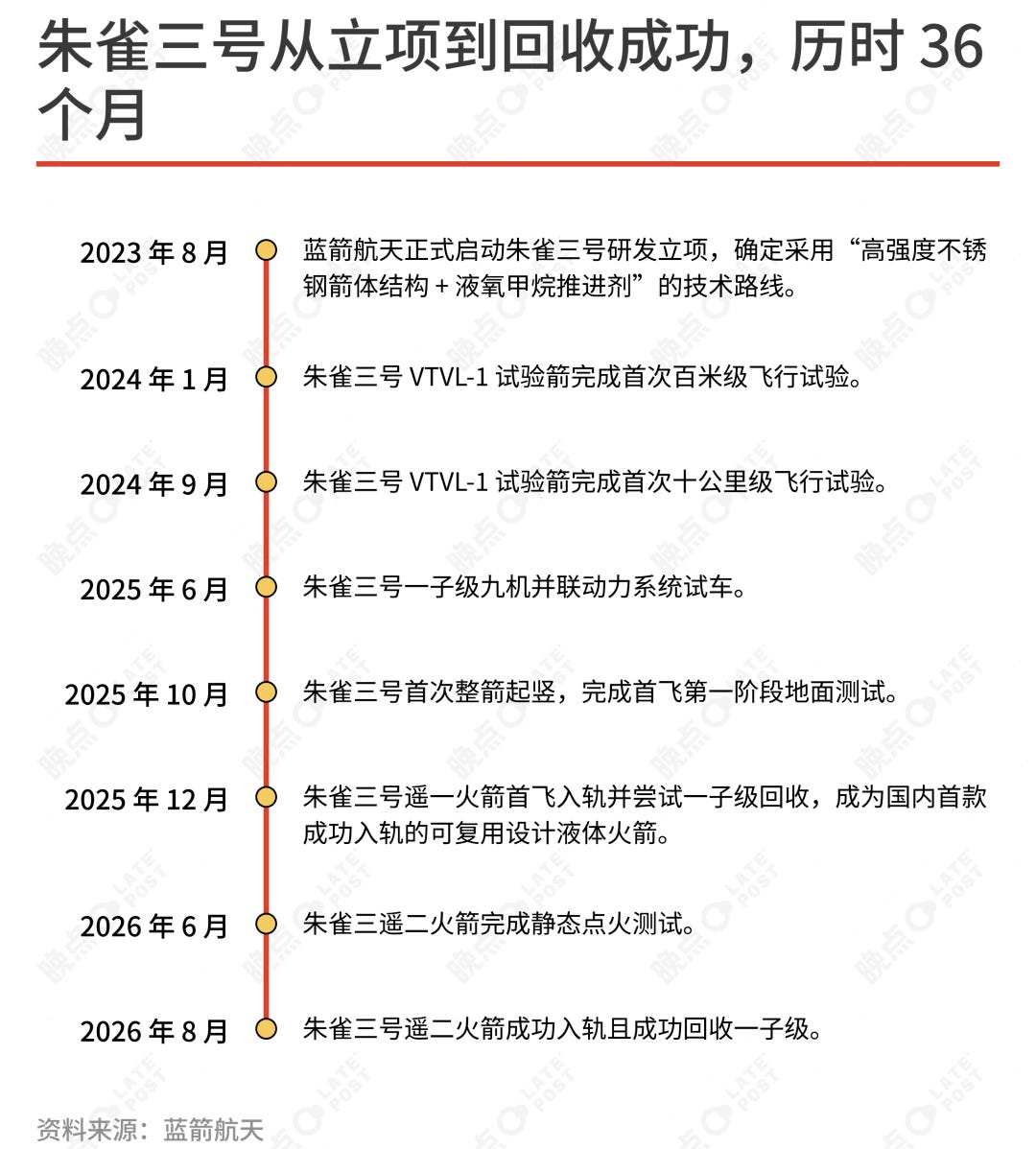
**LatePost:** How did you complete the entire rocket in 28 months?
**Dong Kai:**
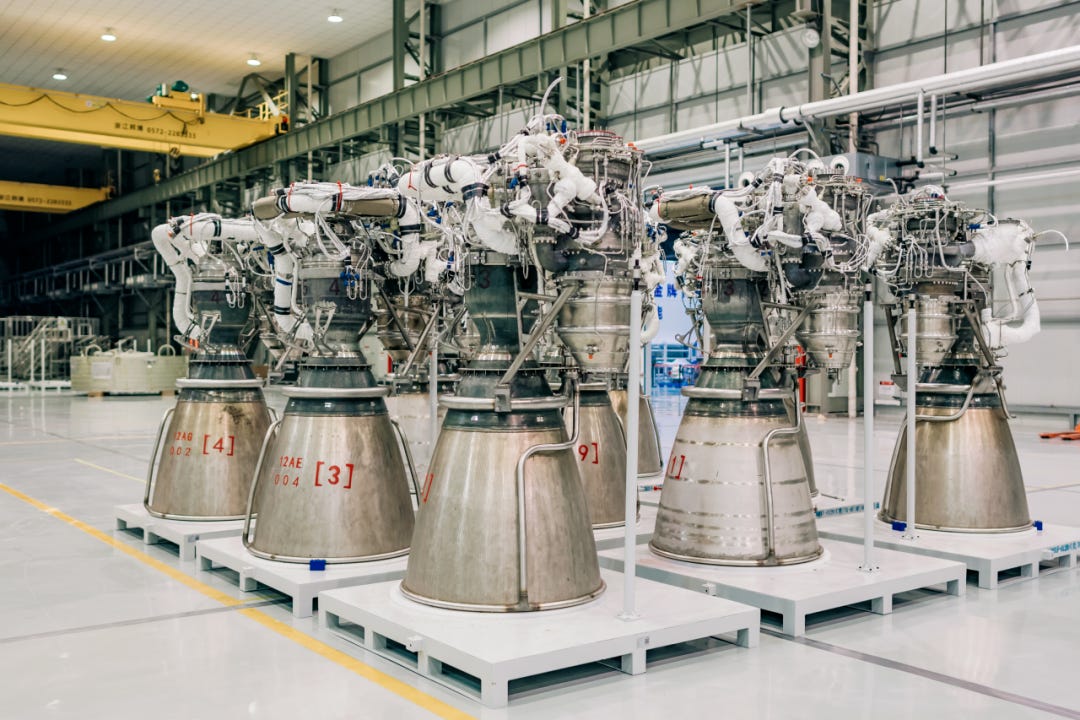
There was preparatory work. The Tianque 12A engine used on Zhuque-3 was developed during the Zhuque-2 era. And the process validation for Zhuque-3 started with test articles as early as late 2022. These accumulations and trial-and-error helped us avoid repeating mistakes.
In engineering, there are no shortcuts – only fewer detours.
We never emphasized mandatory overtime. Instead, we clearly communicated project milestones across all departments. In a highly motivated organization, when everyone else is pushing toward deadlines, how can you tolerate falling behind? That’s basically how those 28 months went.
**LatePost:** How do you break down the challenge of launching something the size and weight of a skyscraper into space and bringing it back safely?
**Dong Kai:**
Project decomposition is organized around major ground tests – modal tests, power system tests, and so on. Each test has corresponding requirements for each subsystem, specifying what state must be achieved by when. It’s like a military operation – each unit must arrive early, never late.
**LatePost:** So each subsystem has autonomy, as long as it meets its targets on time?
**Dong Kai:**
The top commander doesn’t need to micromanage down to the platoon level. As the army group, I tell each division where and when to be – the rest is up to the division commander. This is a key feature of LandSpace’s management – full delegation of authority.
**LatePost:** Is that how it works inside China’s state aerospace system?
**Dong Kai:**
I don’t think it’s a matter of inside or outside the state system – it depends on the rocket program. If a program faces strong external competition and must be completed by a certain deadline, of course you delegate.
The traditional approach does tend to be more granular – even specifying when certain documents should be completed. This places very high demands on the planning department. We know we’re not yet capable of that level of control, so we delegate some autonomy.
**LatePost:** You said the ideal state is to let people be self-driven. That’s a high bar, and rockets aren’t exactly an area where success comes easily.
**Dong Kai:**
This kind of highly motivated organizational culture isn’t achieved through lectures or indoctrination.
First, through systems and institutions. LandSpace advocates “pragmatic innovation and decisive execution,” encourages trial and error, and doesn’t make people worry that “doing more means making more mistakes.” Rewards and consequences are clearly defined.
Second, by providing real-world opportunities. In any organization, no matter the size, the truly effective force is the top 20–30%. These people are often driven not just by compensation but by a sense of achievement and self-actualization. LandSpace happens to provide a platform where they can keep getting real combat experience and building that sense of accomplishment.
Think about it – what frustrates a highly skilled engineer the most? Spending all day on PowerPoint presentations and never having time to do what truly matters. We give them a stage.
That sense of honor is built through battle after battle. I believe this logic applies to most knowledge-based work.
**LatePost:** Rocket engineers need backgrounds in physics and materials – but now many AI companies are also recruiting these brightest minds. How do you attract top talent?
**Dong Kai:**
Our definition of talent is somewhat different. LandSpace wants “moldable talent.” In an industry as innovative as commercial space, I don’t think what people have learned before counts for that much – it just means they can help us avoid a few detours. What we value more is growth potential and learning ability.
The prerequisite is shared values. People who choose aerospace more or less have a sense of national mission. We offer compensation that removes the need for them to weigh personal sacrifice – not “I chose aerospace, so I have to endure poverty.”
**LatePost:** You mentioned that many in aerospace have deep passion and aspiration for this field. How did your own feelings for aerospace develop?
**Dong Kai:**
I first attended a rocket maiden flight in 2016 – the Long March 5. At that moment, nothing else mattered – that was enough. The moment a rocket lifts off is an immense emotional shock for everyone who built it.
Many people love this from childhood. For me, it was in college – when Shenzhou V launched in 2003 and Yang Liwei went to space – that I suddenly felt this industry was truly noble.
I graduated and started working in 2009, just in time for the 60th anniversary of the founding of the PRC. Whether it was learning patriotic songs or the early orientation training, there was a strong patriotic atmosphere.
When you enter this industry, you have to give up a lot because of secrecy requirements – maybe not as extreme as working on weapons, but there are restrictions. Back then, one of the songs we learned was *The Motherland Will Not Forget*. It felt different from what we learned in middle school – it gave you a different feeling. When you’re surrounded by that atmosphere, you can’t help but be influenced and genuinely believe what you’re doing is noble.
Even now, I still feel that way. I can’t explain it, but I feel like I carry a historical mission. From entering the大院 (compound) to leaving it and moving into commercial space – it’s all driven by that original aspiration.
**LatePost:** What’s the most important thing your experience at CASC gave you?
**Dong Kai:**
Engineering discipline training. I was lucky – right after graduation, I joined the Long March 5 and the new-generation rocket program. New projects are great for professional growth.
The commanders I worked with back then – I still admire them. It’s like that scene in *The Decisive Engagement* where the commander says, “Liu Yalou, take note – make the following deployments” – you feel you’re watching a top-level commander. I’ve worked with people like that, and now I unconsciously emulate their approach. That’s the 50-year legacy of China’s aerospace program.
Sometimes I see press portrayals of the state teams as competitors to be disparaged. I think that’s a huge misunderstanding – it greatly underestimates China’s decades of aerospace accumulation and its organizational capabilities.
**LatePost:** What aspects of the national teams do you think are underestimated?
**Dong Kai:**
First, they always have to control the floor – the minimum acceptable outcome. That’s a different logic from commercial space, which takes risks in pursuit of higher ceilings. It’s like why you go to a top-tier hospital instead of a street clinic – the clinic might advertise “we once cured a terminal case,” pursuing the best possible outcome, while you go to a major hospital because its baseline is reliable. The same logic applies to state aerospace decision-making.
Second, all martial arts come from Shaolin Temple (天下武功出少林). China’s commercial space industry’s true “Whampoa Military Academy” is the state system – most of our early employees came from there. If you consider the state system as part of China’s commercial space landscape, it’s the flagship, bearing the burden of trial and error. We’re taking fewer detours today because they’ve already blazed the trail.
**LatePost:** Looking at SpaceX’s history, many of their early efforts were things NASA had already done – just done more cheaply. But eventually there’s a gear shift – they also have to take on the role of leader.
**Dong Kai:**
Yes, exactly. On a broader scale, SpaceX is the big brother of global commercial space now.
**LatePost:** Over the past two decades, every aspect of aerospace technology has changed – stainless steel materials, engine technology. If you take a systematic view, what are the major shifts you see in the field?
**Dong Kai:**
In 2009, China’s aerospace was always talking about catching up with the world. Today, if not for SpaceX, China would be number one – the state program has surpassed NASA. The United Launch Alliance (the Lockheed Martin-Boeing joint venture serving the U.S. military and NASA), once considered unassailable, has transformed dramatically. Who would have thought Boeing’s “space black shop” would also face setbacks?
Second, the development of heavy-lift rockets has exceeded expectations. Back then, people felt building a heavy-lift rocket was a lifelong endeavor. For Long March 5, if you count from feasibility studies, it started in 1986, engine development in 1996, project approval in 2006, and launch in 2016 – forty years in total. When I first joined the Long March 5 program, senior colleagues told me, “You’re lucky – you get to work on a new rocket,” meaning I’d have a chance to go into battle, like a soldier finally getting to fight a major war.
In retrospect, the changes from 2016 to 2018 were dramatic. SpaceX went from Falcon 9 to Falcon Heavy in just over two years. For me, that was an even bigger shock than watching Falcon 9 land. And Starship even more so.
Third, there are now over 80 rockets awaiting launch in China – named and unnamed. In the past, the Long March series had just over a dozen. For those of us in the industry, it feels like the spring of commercial space has arrived.
When I first started working on rockets, I thought maybe after Long March 5, if I was lucky, I’d get to work on heavy-lift rockets. Now the landscape has changed entirely – the entire global aerospace industry has a new vitality.
When Musk first talked about launching 42,000 satellites, we all thought that number was inflated. That became a lesson for me – never make judgments too quickly.
We’ve always had respect for SpaceX – not for the grand narratives, but for the fact that after three Falcon 1 failures, they dared to organize a fourth launch – “They can do that? They dare to do that?” After that, it seemed like everyone had a psychological anchor: I can fail three times.
**LatePost:** Beyond Zhuque-3, what are LandSpace’s next technology priorities?
**Dong Kai:**
The core priority for Zhuque-3 going forward is engine upgrades to improve payload. The Tianque 12B engine should be delivered around the end of this year or early next year. Meanwhile, LandSpace is also developing the Lanyan full-flow engine, which has undergone many test firings, but it will take considerably longer to integrate into the full rocket.
Larger-scale rockets are still in the technology demonstration phase. Project timing will depend on market demand and also on how Zhuque-3 operations perform. At this stage, our priority is to increase Zhuque-3’s launch frequency to 30–50 times a year.
**LatePost:** That number doesn’t sound very aggressive.
**Dong Kai:**
In 2023 and 2024, the total launch volume for all of China was about 160 tons per year. What does that mean for Zhuque-3? In reusable mode, that’s just over a dozen launches.
**LatePost:** Historically, even the U.S. state teams couldn’t afford failures. Now people think commercial space has more room for trial and error. But rockets are still expensive – how does LandSpace balance experimentation with safety and success?
**Dong Kai:**
It’s not that contradictory. First, we absolutely do not tolerate management or process risks. Second, we have systems in place to ensure personnel safety – unmanned operations, automation, remote control.
**LatePost:** But as a commercial company, you still have to control costs.
**Dong Kai:**
Our core reason for cost control is survival – not improving gross margin by a few percentage points on a financial statement. We don’t calculate how much margin increases if we cut costs from 50 million to 30 million. Rather, if we save that 20 million, we can run more tests and have more opportunities to iterate. There are red lines and bottom lines we cannot cross in design decisions – beyond that, we cut unnecessary or non-essential expenses.
**LatePost:** Still sounds difficult. What’s the fundamental advantage of the commercial approach?
**Dong Kai:**
Greater supply chain flexibility.
The state system has strict quality control requirements for its suppliers – they use supplier certainty to counter the uncertainty of new products.
The state team’s supply chain is constrained not only by economic indicators but also by various regulatory requirements. It’s not just a straightforward transaction – if something goes wrong, accountability must be traced back to individuals. This model raises costs and extends timelines, but it keeps the floor under control.
Using market-based supply chains gives us access to cheaper components – and “cheaper” doesn’t mean squeezing supplier margins. It’s because China is a major industrial power with many highly competitive sectors, good efficiency, and high yield rates. In the trade-off between cost and reliability, we can be bolder. But higher flexibility is both an advantage and a disadvantage – controlling the floor can also be more difficult.
This places greater demands on our quality control. We can’t just issue a statement of work to a supplier and accept their word that “it’s done.” We need our own ways to verify and test whether suppliers actually meet the standards, rather than building reliability on their commercial credibility. In the past, rocket designers signed off on documents and their job was done. Now we’re also responsible for outcomes. Comparing the two models, commercial space places higher demands on technical personnel.
**LatePost:** In terms of organization, personnel, and collaboration, how different is it from your time in the state system?
**Dong Kai:**
It looks similar on the surface, but fundamentally quite different.
Ultimately, it’s about quality control. In the state system, the organizational philosophy is to assign dedicated personnel to every task, break systems down into finer pieces, control the floor, and ensure stability even with staff turnover. The cost is increased system complexity.
From an engineer’s perspective, almost all quality issues arise at handoff points – just like in warfare, breakthroughs happen at the seams between two units. If a unit fights alone, it knows its responsibility and won’t let the enemy through. The traditional system relies on more robust procedures to ensure handoffs go smoothly.
The result: the state aerospace system has dozens of times more people than us. LandSpace, with 1,000–2,000 employees, is considered large in commercial space – but they have tens of thousands, yet their efficiency isn’t 10 times greater, because a significant portion of their workforce is dedicated to managing the risks of organizational complexity. They’ve found their balance.
Commercial space inherits this system but reduces complexity. We keep the critical architecture and the principle of each unit guarding its own territory, but we don’t divide personnel too finely – we maintain higher integration. A task that might require five or six handoff stages could be handled by a single team that bridges them all, potentially reducing handoff risks. Increasing individual responsibility may increase risk, but it can also reduce it. It’s all about balance at different stages of organizational development.
Our COO said late last year that LandSpace will remain a startup for a long time – solving quality issues and reducing management complexity remain key tasks.
**LatePost:** As commercial space becomes more visible to the public in recent years, have the types of talent you attract changed significantly?
**Dong Kai:**
Commercial space companies tend to do more experienced hiring. The density of fresh graduates with top talent isn’t as high as in the state system.
New graduates benefit from the structured training in the state aerospace system. We do have development programs, but not as comprehensive as “Shaolin Temple” – we tend to throw people into the battlefield.
For experienced hires, we’ve also brought in people from other industries, like automotive. Traditional engineers aren’t as cost-sensitive – they assume things should cost what they cost. But people from automotive tell us, “In our industry, this doesn’t cost nearly that much.”
**LatePost:** Can you give an example?
**Dong Kai:**
Take ambient temperature sensors for rockets – they cost tens to hundreds of yuan each. People from automotive say, “We use these for a few yuan – how can you be charging so much?”
**LatePost:** Doesn’t aerospace require specific certification standards for all components, which drives up cost?
**Dong Kai:**
We certify based on results. For components where we can control the outcome, the validation process is faster. I even think this is likely the trend for commercial space. Some things may be called “automotive-grade” on the ground – but if they’ve flown to space and proven themselves, I’d say calling them “space-grade” isn’t a stretch.
**LatePost:** When did you start believing that a private company building a reusable rocket was definitely achievable?
**Dong Kai:**
We believed China’s reusable rockets would definitely succeed.
From a technical logic standpoint, LandSpace had accumulated power system experience with Zhuque-2. The Zhuque-3 maiden flight was also successful. The remaining critical technology was the 3.3-kilometer recovery phase. Given the technical conditions at the time, we couldn’t guarantee 100% success, but we couldn’t see any rigid technical obstacles in any part of the process.
But really, you don’t need to overthink the final outcome. If we’re talking about operational costs and results, we trust our founder Zhang Changwu’s judgment. If he’s bold enough to take the bet, we don’t need to overcomplicate things – we just focus on the engineering, make the most of limited resources, and maximize our chances.
However hard it gets, it can’t be harder than Musk’s early days – even Armstrong said it wouldn’t work. That’s the significance of pioneers – they prove something can be done. Since he can, so can we.