Every brand wants to drive sales and increase revenue, and retail media is a perfect way to achieve this. With first-party data and targeted advertising, retailers can monetize traffic and boost sales. Currently, retail media accounts for one-fifth of worldwide digital ad spend, and some experts predict it will surpass other digital advertising formats by 2027.
This blog post explains retail media for eCommerce, their benefits for retailers and brands, as well as their role in digital advertising. Let’s discover more about this new engine in digital advertising now!
What Is Retail Media in eCommerce?
Retail media is a type of advertising that allows brands to promote their products on a retailer’s website, app, or marketplace and reach consumers who may make instant purchases there. It works in a simple way: a brand chooses a retail media network like Amazon or eBay and pays for the display of its advertisements to shoppers there. Such media allow brands to collect first-party commerce data from customers, including search queries, browsing behavior, and purchase history, to make ads more targeted and effective.
What types of ads can you see on retail media sites and apps? The most popular examples are as follows:
- Sponsored product listings. You see organic-looking products in product listings, which boost visibility and purchases.
- On-site display ads. These are banner or visual ads that use first-party data to build brand awareness and improve sales. They are placed on the retailer’s and publisher’s own digital platforms, no matter whether it is a website or an app.
- Off-site retargeting. This approach is applied to users who have already visited the website but haven’t converted yet. These visitors see personalized ads on social media websites, apps, and third-party platforms to re-engage with these shoppers and bring them back.
- Search ads within eCommerce platforms. Retail search ads are sponsored product listings that are displayed on e-commerce sites in response to user searches. They look like organic search results
Why Retail Media Is Growing
Retail marketing is one of the fastest-growing digital ad channels in the world. Global retail media spending is expected to exceed $184 billion, and it is projected to reach $312 billion by 2030.
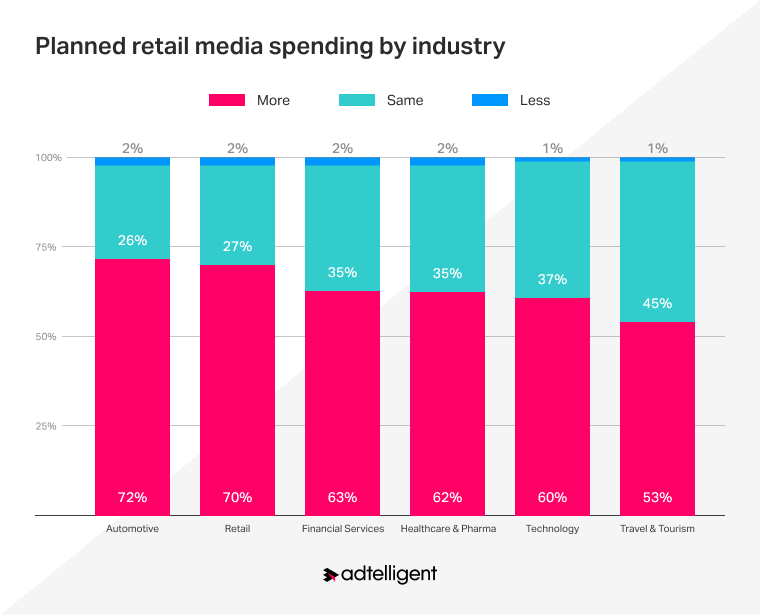
The key drivers that make retail media grow and contribute to retail media trends are the following:
Decline of Third-Party Cookies
Third-party cookies are currently being phased out due to privacy regulations, browser restrictions, and changes in Chrome policies. Their disappearance results in several negative consequences for eCommerce companies, including the loss of reliable tracking, precise targeting, and clear attribution, but the fact that retail media uses first-party data within their own ecosystems changes everything. Retailers have access to other important data, which allows them to achieve reliable targeting without cookies and retail media optimization.
Retailers Owning Valuable First-Party Data
Retailers can collect much first-party data from customers, which is more accurate and reliable than third-party data. It is logged-in users, search behavior, and purchase history that are necessary to target shoppers more directly. Vendors can also segment customers by their shopping habits and preferences, allowing them to adapt loyalty programs and in-store data to make more personalized offers to potential buyers.
It also results in the provision of closed-loop management to link ads directly to sales. All this results in more effectiveness, measurability, and attractiveness for brands.
Brands Seeking Measurable ROAS
Brands aim to achieve a clear and measurable return on ad spend (ROAS), and retail media makes it possible thanks to the operation within a closed ecosystem. They can track customer experience from the first ad impression to a purchase, so they can easily calculate the revenue of every campaign and optimize it on the basis of performance data. Retail media networks also provide SKU-level insights to see which products drive returns, so it reduces wasted ad spend and adds confidence in marketing investments.
Growth of eCommerce Marketplaces
The number of e-commerce marketplaces grows daily. Such platforms as Amazon, eBay, or Alibaba Group have millions of visitors every day, so they become high-intent traffic hubs that can influence purchase decisions. They also provide ready-made ad formats and can easily integrate ads in shopping experience.
How Retail Media Ecosystem Works
Retail media networks have their own ecosystems, which not only make sales but also organize the whole programmatic advertising for eCommerce.
Retail media works as a connected system where multiple players collaborate to deliver relevant advertising within the shopping experience. Its effectiveness depends on how well these participants align:
Brands (demand side)
Advertisers who invest in retail media to promote their products, such as Unilever, Coca-Cola, L’Oréal, and Vodafone.
Retailers (supply side)
Platforms that own the audience and inventory, enabling ad placements across their websites, apps, and in-store environments, including Target, Costco, and Walmart.
Example: Walmart is rapidly turning its retail media business into a major revenue driver, reaching $6.4B in ad revenue in 2025 (+46% YoY). Growth is fueled by strong ecommerce performance, rising marketplace seller demand, and expansion into CTV through Vizio. At the same time, AI-powered shopping (like the Sparky assistant) is increasing customer spend. This shows how retailers can build full-funnel media ecosystems, combining on-site ads, off-site channels like CTV, and AI-driven personalization to unlock new revenue streams.
Agencies (demand-side partners)
Intermediaries that plan, execute, and optimize campaigns on behalf of brands, for example, Publicis, Amazon, and The Trade Desk.
Consumers (the core driver)
Shoppers whose expectations for relevance and seamless experiences shape how retail media operates. Their behavior and data guide both brands and retailers in delivering more personalized, effective ads.
A retail media network unlocks great revenue streams for retailers who can sell advertising space, cooperate with brands to strengthen their relationships, and provide detailed reporting based on first-party data.
Retail media for eCommerce: Use Case
Let’s look at a realistic retail media scenario using a global brand like Apple.
Apple launches a new iPhone series and activates retail digital marketing and advertising campaigns across multiple retail media networks in different regions, aligning each with specific goals (e.g., awareness, conversion, product discovery).
Within these networks, ads are delivered across retailer-owned inventory, including sponsored search results, product detail pages, and homepage placements.
Retailers use their first-party data to identify relevant audiences, such as users browsing smartphones, showing interest in Apple products, or purchasing related accessories.
Apple can then:
- run on-site campaigns (within retailer environments) to drive conversions, and
- activate off-site campaigns (via programmatic channels) using retailer audience data for broader reach.
Retailers monetize this through media spend and performance-based revenue, aligning incentives with campaign success.
As a result, Apple benefits from higher conversion rates, incremental sales, and improved return on ad spend by leveraging retailer data and high-intent environments.
Benefits for Brands
Every brand that turns to the retail media network for advertising services gets several unmatched benefits, including the following ones.
High Purchase Intent Targeting
This benefit allows brands to reach consumers who are actively searching for products by analyzing the first-party data. They place ads directly in search results and product pages to encourage users to make a purchase decision and increase the likelihood of making a purchase.
Closed-Loop Measurement
This pro makes it possible to track a full shopper journey from ad exposure to making a purchase. Retailers place direct link ads to sales within their ecosystems and can make conclusions about the success of the campaigns. By measuring key metrics, they make the necessary performance adjustments and connect user interactions with actual transactions. It helps to identify the most popular products and audiences, too.
Increased Conversion Rates
Retail media platforms can easily reach shoppers with a strong purchase intent and provide them with all the necessary conditions to increase the likelihood of conversion. Taking into account the real shopping behavior, they provide relevant ads and get better engagement and more clicks. Since customers have a buying mindset, the chances that they will complete a purchase are rather high.
Better Product Visibility Inside Marketplaces
Retail media ads allow brands to appear at the top of search results and listing pages. This visibility increases the chances of noticing products and helps lesser-known products compete with renowned brands. Higher traffic leads to increased sales and better rankings since products are shown to relevant audiences. It results in stronger performance and more impactful visibility.
Access to Retailer First-Party Audiences
Retailers collect detailed data from shoppers’ behavior, such as search history, product views, and buying activity. It allows attracting a high-value audience and segmenting it by purchase patterns and preferences. Targeting is getting more precise, and brands connect with consumers who have a higher chance of converting.
Benefits for Retailers
Retail media isn’t only beneficial for brands. Retailers that build or participate in retail media networks unlock new monetization opportunities and strategic advantages:
- New revenue streams. Brands pay for ad placements within retailer-owned inventory, allowing retailers to generate revenue not only from product sales but also from advertising.
- Traffic monetization. Retailers can monetize their audience by offering advertising access to high-intent shoppers. In addition to media placements, they may provide aggregated, privacy-safe insights to help brands optimize campaigns, pricing, and product strategies. Some models also include performance-based revenue (e.g., cost-per-click or cost-per-sale).
- Providing value to brand partners. When a retailer meets their partners’ expectations and becomes a reliable assistant, it leads to an increase in the number of new customers and a higher trust level in the market.
- Leveraging shopper data responsibly. Retailers may share some insights on first-party data with brands and benefit from that. Deep research and analytics may be very valuable information for clients, so it should be collected and reported in a clear and precise way.
An important conclusion to these benefits is the fact that retailers that used to be sellers gradually become media owners, who monetize the attention of their customers. They get paid not only for sales but also for digital visibility and insights, so retailers grow into hybrid businesses that combine commerce, media, and data.
Learn more about retail media measurement in the blog post about the 35ms ad serving standard!
Role of Retail Media Platforms
Retail media platforms are what turn e-commerce traffic into a high-margin revenue engine. Instead of relying only on product sales, retailers can monetize every visit, search, and product view through advertising, often with stronger margins than commerce itself.
Here’s how it works in practice:
A user searches for “wireless headphones” on an e-commerce site. A retail media platform enables sponsored products to appear at the top of results, promotes premium placements on product pages, and can even extend that user into off-site campaigns across the open web. All of this is powered by first-party data, browsing behavior, purchase history, and real-time intent signals.
For retailers, this means:
- Higher revenue per visitor — monetizing attention, not just purchases
- Better control over inventory and pricing — managing demand from multiple advertisers
- Scalable brand partnerships — supporting dozens or hundreds of campaigns simultaneously
Retail media platforms also bring automation and transparency into the process from campaign setup to performance tracking, making it easier to grow media operations without increasing complexity.
However, it is important to choose an advertising technology provider, like Adtelligent Retail Media Platform, which features multiple traffic sources and premium ad inventory for every brand. By using the services of this platform, every customer can expect to enable different ad solutions and types:
- Ad inventory management
- Audience targeting
- Campaign optimization
- Performance analytics
- Off-site advertising activation
Adtelligent allows advertisers to launch cross-platform, omnichannel campaigns using a variety of capabilities, including sponsored product ads, display ads, off-site retail media, programmatic integrations, and real-time bidding and campaign analytics. Brands can seamlessly connect and activate data across multiple touchpoints within one ecosystem.
How A New Retail Media Trend Influences E-commerce
Retail media is constantly evolving, and its goal has shifted toward turning traditional customer interactions into measurable, monetizable touchpoints. Therefore, modern networks are blending commerce, advertising, and data into a single ecosystem, advancing in first-party data, making targeting AI-driven, and focusing on closed-loop attribution.
We can follow how modern retail media networks are developing programmatic retail media and omnichannel advertising to offer clients a full spectrum of solutions in one place and with a minimum of involvement. Such ecosystems are working on more effective privacy-first data strategies and AI-driven optimization to provide a more success-oriented approach, while the integration with CTV and DOOH should lead to more conversions and sales in a short-term perspective.
#advertisers#cookies#monetization#programmatic advertising#publishers#retail media#video ads