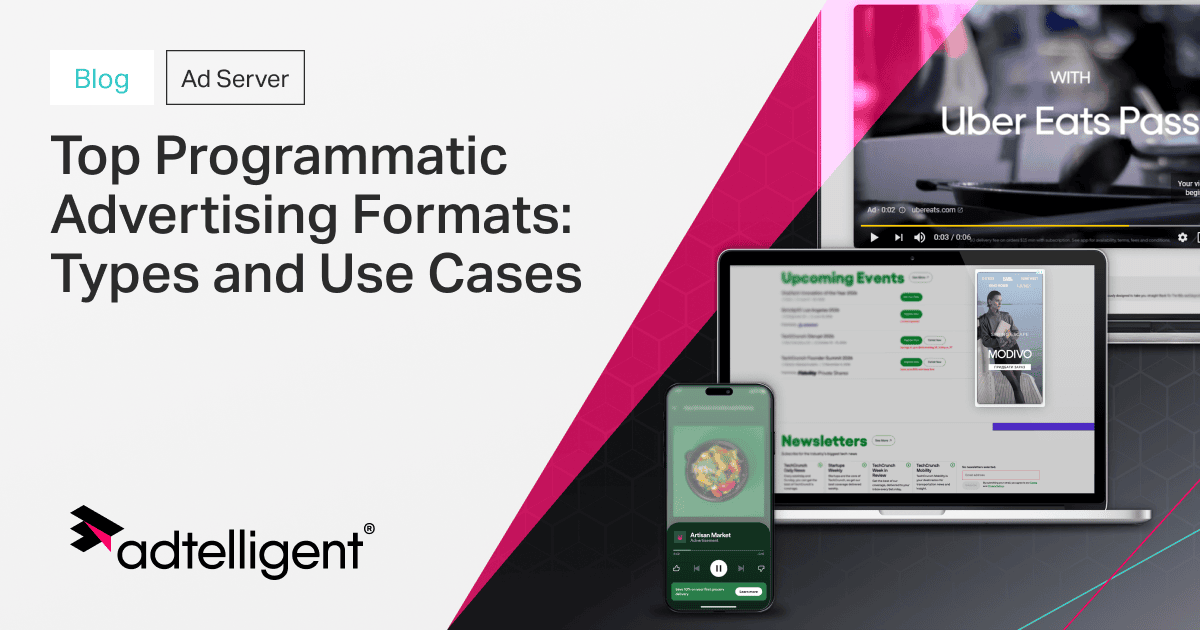
Global programmatic advertising spending is projected to reach $821 billion in 2026. It captures over 90% of all digital display ad spending worldwide and has changed the old-school advertising process drastically. The programmatic advertising is no longer limited to standard banners. Nowadays, it includes a variety of formats designed for different goals.
Marketers work with client reach and brand awareness, trying to improve engagement and performance as well as achieve monetization. It means that the choice of the right programmatic advertising format can improve campaign outcomes and increase inventory value for publishers and ad networks. Let’s take a look at the available programmatic ad formats, their types, and use cases to monetize more effectively and let your brand grow!
What Are Programmatic Advertising Formats?
Different digital ad units and creative experiences, such as display, video, and audio, which are purchased and placed via automated data-driven platforms, are known as programmatic advertising formats. These digital ad formats optimize audience targeting in real time.
It is important to mention that programmatic ad formats can differ in the following aspects:
- creative type
- placement
- device or environment
- user experience
- campaign goal
- monetization potential
Exclusive ad formats for publishersmake their user experience more diversified and keep them engaged. It leads to higher earnings, and advertisers can get creative ads that comply with Google policies and follow the latest programmatic advertising trends.
Main Programmatic Advertising Formats
There are different programmatic advertising formats that help to reach an ideal customer at the right time and place. They have a range of differences and run effectively in various campaigns depending on the goal and type. Every ad format can be more cost-efficient than many other examples.
Here, you can discover the most popular types of programmatic ads leveraged on a regular basis. They fit a vast majority of well-defined objectives, but each of them has some peculiarities described below.
Display Ads / Programmatic Banners
Display banners are the core of digital media thanks to their flexibility and scalability. Such programmatic ads usually consist of text and images and appear like traditional banners, interactive banners, and pop-ups. They are also more cost-efficient and can be placed in different locations, including standard, leaderboard, sidebar, in-content, and sticky placements.
It is important to mention that this type of display ad is purchased and sold via automated ad platforms, private marketplaces, and programmatic direct deals with publishers. And the main value from them can be achieved through applicable targeting, frequency control, right pricing, and the quality of placement.
Main goal: Display advertising helps brands to reach a more targeted audience and do that more efficiently. They re-engage users who have already visited the site and increase conversion rates through consistent traffic generation.
Use case example: A publisher monetizes website traffic with banner placements across desktop and mobile pages. And advertisers use banners for retargeting users who visited a product page but did not convert.
Best for: increasing potential customer reach, improving the performance of campaigns, retargeting users who have already visited the website, and getting basic monetization as a publisher.
Publisher/ad network value: programmatic bannershelp to monetize inventory in a scalable way, with higher fill rates, access to global demand, and operational efficiency. They help to maintain flexible inventory management, monitor performance metrics, and optimize placements, formats, and prices. It leads to more scalable monetization through automated advertising technology.
Video Advertising
Programmatic video ads combine audio-visual storytelling and scalable automated buying, covering more than one environment. Today, advertisers buy videos across a variety of platforms and of different types. If these are live streaming videos, they may be ads covering a range of formats like ad stitching, companion executions, and cross-screen delivery. In-stream video ads interrupt the main content and are divided into pre-roll, mid-roll, and post-roll.
One of the latest trends is a Server-side ad insertion to stitch commercials seamlessly across different platforms. Out-stream ads, or so-called accompanying content ads, run outside the video player, are a popular practice, and can be skipped if you want, like in in-stream ads as well. You can come across in-banner videos and rewarding in-app videos, too.
A vast majority of video ads are played on popular platforms like YouTube, TikTok, or CTV. They can easily attract attention, but producing such videos requires a lot of effort. Such videos have a 27x higher CTR than banners and a much higher CPM than display ads. As a result, video ads achieve high recall and brand lift, with a huge boost in purchase intent. They are ideal for retargeting and awareness, so the viewability and completion rates of these ads make them a compelling option for advertisers.
Main goal: Videos are better for telling brand stories and demonstrating product value. They increase brand awareness, visibility and recognition, increase engagement among visitors. Publishers can generate premium advertising revenue by using the most effective video ad monetization strategies and more valuable inventory.
Use case example: A streaming publisher monetizes video content with in-stream ads. An advertiser uses pre-roll video to introduce a new product to a broad audience.
Best for: product launches, premium publisher placements, app installs, and e-commerce remarketing, higher engagement rate, and getting higher revenue from ad placement.
Publisher/ad network value: Publishers get more revenue with video ads. This ad type leads to a higher level of engagement and cross-platform monetization. Ad networks get their own benefits by offering high-value video placements, producing better margins and campaign performance metrics, as well as offering advanced audience targeting.
Native Ads
Native ads appear in the publisher’s content as if they fit it the most naturally. They mirror the look of the website and don’t look intrusive, so these ads are always added to social media feeds, content recommendation widgets, and promoted search results.
Programmatic native ads are bought automatically and placed to mimic the site layout, style of writing, or publisher environment. So they take the form of sponsored article placements, promoted listings, or native placements on publisher websites and apps, though it is difficult to differentiate them from general content. Though natives can be delivered both manually and programmatically, advertisers get granular control of them, and the buying process runs through automated pipes.
Main goal: Audio ads drive content discovery and engagement without disrupting the user experience.
Use case example: A news publisher monetizes article pages with native recommendation blocks. An advertiser promotes an educational article or product guide through native placements.
Best for: promoting branded content, articles, recommendations, and educational campaigns in a way that feels natural to the user experience. They work well for building awareness, trust, and engagement without interrupting the content flow.
Publisher/ad network value: Publishers can earn money by maintaining a positive user experience and preserving a high engagement rate. Ad networks obtain a high-performing format and expand inventory opportunities greatly.
Rich Media Advertising
Rich media advertising is a bridge between display and video ads that features interactive and dynamic units. They react to user actions or show layered creative, so they are a perfect choice when static ads don’t look effective. The selection of ad formats in rich media is rather extensive, so they can be represented by:
- expandable ads
- carousel ads
- interactive banners
- shoppable ads
- interactive video
- gamified ad units
- dynamic creative elements
When it comes to practice, you can recognize these ads in expandable units, shoppable overlays, swipeable galleries, and interactive product carts. They become a perfect option for brands that need interaction from the first minute of their website visit and multiple product showcases. They incorporate video, audio, 3D elements, forms, or user interactions, but retain affordability at the same time.
Main goal: Rich media ads boost engagement and enhance brand experience and memorability.
Use case example: A retail brand launches an interactive carousel ad where users can explore several products directly inside the ad unit.
Best for: higher user involvement rate, numerous product launches, running premium campaigns that include lots of different aspects, and delivering high-impact creative experiences.
Publisher/ad network value: Publishers can expect to get higher advertising rates on special locations, and ad networks can benefit from showcasing products and brands more effectively thanks to more time spent with the ad.
DOOH Advertising
Digital Out-Of-Home or DOOH advertising provides excellent opportunities to benefit from the logic of programmatic media via smart scheduling, better audience targeting, and more flexible budgeting. The main ad placement areas are transit hubs, airports, retail spaces, and office buildings, etc. You can find screens and digital billboards in malls, gyms, taxis, elevators, and other public spaces. These ads promote location-based and context-based buying, which can be triggered by time-of-day, weather, traffic, or audience.
It enables location-aware planning and helps in achieving the key objectives of the DOOH ad format, including increasing brand awareness in high-traffic areas, retail and event support, running location-triggered campaigns, and connecting online and physical presence to get higher ROI. This type of ad increases visibility, promotes intelligent placement, and the surrounding context.
Main goal: Digital out-of-home advertising allows reaching people in physical environments with digital, data-driven outdoor advertising.
Use case example: One of the ad examples is when a brand runs programmatic DOOH ads near shopping malls during peak hours and adjusts creatives based on location, time, or audience context.
Best for: DOOH ads maximize brand awareness and are a perfect option for running local campaigns. They contribute to offline-to-online activation when paired with mobile apps and provide a large-format visibility.
Publisher/ad network value: Digital Out-of-Home ads help publishers monetize physical screens in locations and increase revenue thanks to optimized inventory utilization. Ad networks get access to premium real-world advertising inventory that provides campaign reach beyond digital devices.
Audio Advertising
Audio ads are special ads that appear before (pre-roll), after (post-roll), or during (mid-roll) audio content and in the user’s window of attention. This type of ad aims at users who prefer to listen to content, so this new programmatic ad format is only gaining pace.
Advertisers and agencies can utilize audio ads in different ways. These can be podcasts and pre-roll advertisements, ads on music streaming platforms, and digital radio. It is possible to explore rewarded ads, where users get a bonus for listening to the audio, and interactive ads that support interaction through voice commands, taps, swipes, or clickable visual banners. Most of these options work thanks to the Server-Side Ad Insertion system that allows adding this audio content into the stream or piece before this content reaches a listener.
Programmatic audio advertising is considered more passive, so it is often used next to other media formats. At the same time, audio ads allow reaching busy people efficiently and offer new experiences to customers via audio apps in particular. The Nielsen research says about a 70% brand recall rate for this ad format, and advertisers can utilize the same targeting algorithms as for video and display ads.
Main goal: audio ads aim at reaching users even if they don’t use the screen and build a brand recall by means of audio impact on them.
Use case example: A music streaming app monetizes listening sessions with audio ads between tracks. A brand uses audio ads to reach commuters, gym-goers, or podcast listeners.
Best for: content exploration and improving user engagement. They allow achieving soft conversions and less intrusive programmatic monetization.
Publisher/ad network value: With audio ads, publishers get an additional stream of revenue and achieve a high listener attention that guarantees an excellent added reach rate, being less disruptive than other types of programmatic ads. Ad networks get access to premium inventory and audience segments that may be difficult to reach.
Final Thoughts
The selection of programmatic advertising formats is rather extensive, but it is important to understand that they aren’t interchangeable. You can’t choose the best format once since it should be adapted to campaign goals, audience behavior, creative resources, and buying setup. Every format has its own goal, use case, and monetization value as well, so businesses need flexible programmatic infrastructure to support different formats, reach audiences across channels, and optimize revenue.
If you want to select the best combination of ad types for your campaign and maximize the benefits of online ads, you need a reliable assistant. Adtelligent is an ad-serving provider offering holistic demand management and intermediation solutions for publishers. The company has established a new standard for managing ad inventory for programmatic buyers, enabling it to take your advertising campaign to the next level and help your brand achieve its goals and increase awareness.
#ad server#ad tech#audio ads#dai#display ads#native advertising#programmatic advertising#publishers#video ads